
The Impact Of AI On Business Models
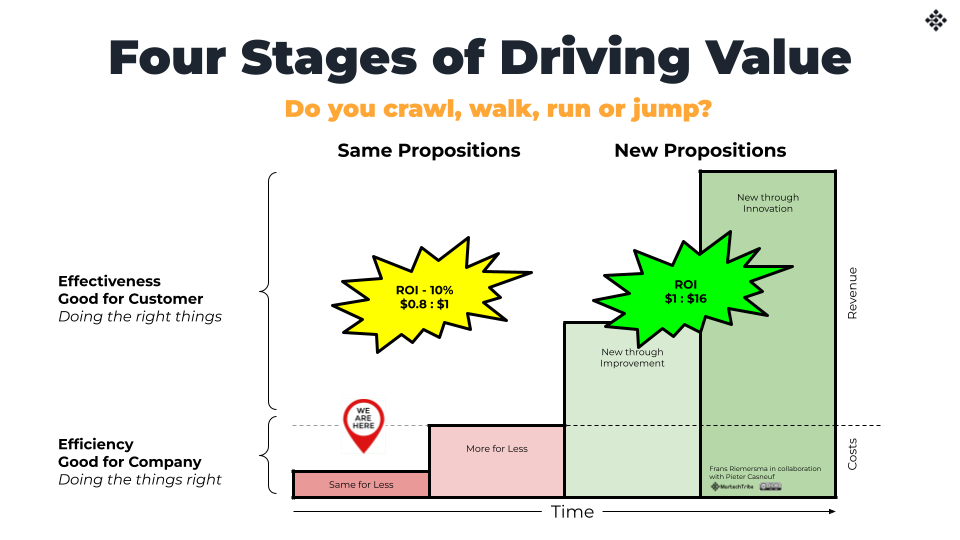
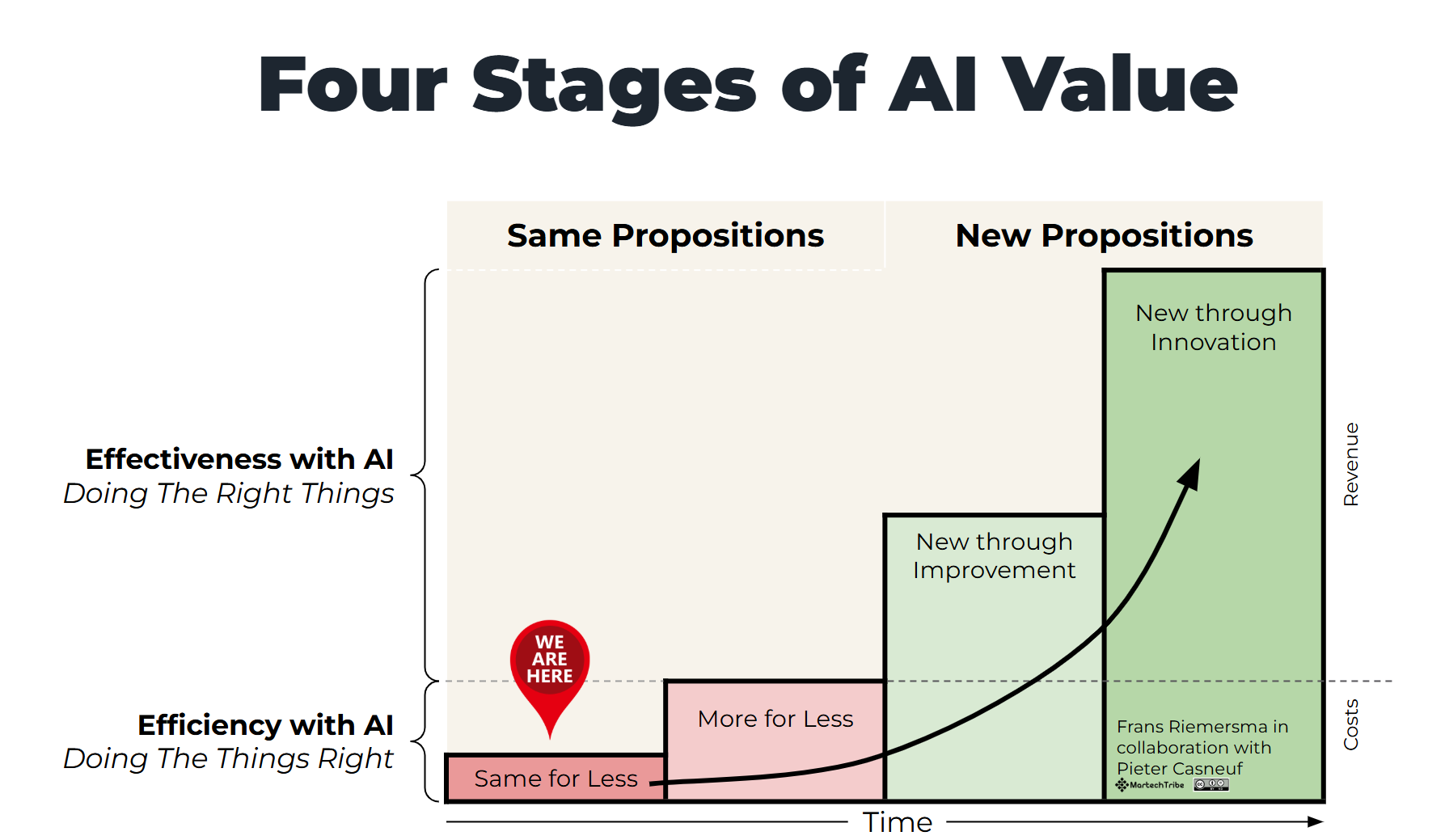
The real AI leap hasn't happened yet. Most companies are still optimising their carriage. 88% of organisations now use AI in at least one function. Only 6% report significant enterprise-wide impact. The majority are not failing at AI. They are succeeding at the very early stage of AI value. There are four stages in total.
The Carriage Problem
Every new technology wave starts the same way. You get a new capability, and you point it at your existing problems. Rational. Safe. Measurable. Also, how you end up bolting an engine to a carriage.
The first cars weren't cars. They were horses replaced by combustion. Same frame, same seating, same roads. It took decades before anyone redesigned the chassis from first principles. The technology arrived long before the thinking caught up.
AI is doing the same thing to us. Forrester calls it the micro-productivity trap: firms optimise tasks without rethinking value creation. Only 21% of organisations using GenAI have redesigned even some workflows (McKinsey, 2025). The other 79% are building very fast carriages.
If we use Peter Drucker's distinction between doing things right (efficiency) and doing the right things (effectiveness), then efficiency saves money (faster and cheaper ingredients for the existing pie), while effectiveness makes money by growing the pie. Both matter. But they require completely different organisational muscles.
Think of it as the factory versus the laboratory. The factory is built for exploitation: scalability, predictability, high performance. It runs proven customer journeys and optimises for the proven product-market fit. It shows up clearly on the balance sheet as a license fee or total cost of ownership.
The laboratory is built for experimentation: agility, flexibility, serendipity. It tests new, unproven journeys, chases problem-market fit, and generates future revenue. The critical asymmetry: there is no line item for "missed opportunity" on any balance sheet. That is exactly why the factory always wins the internal budget argument.
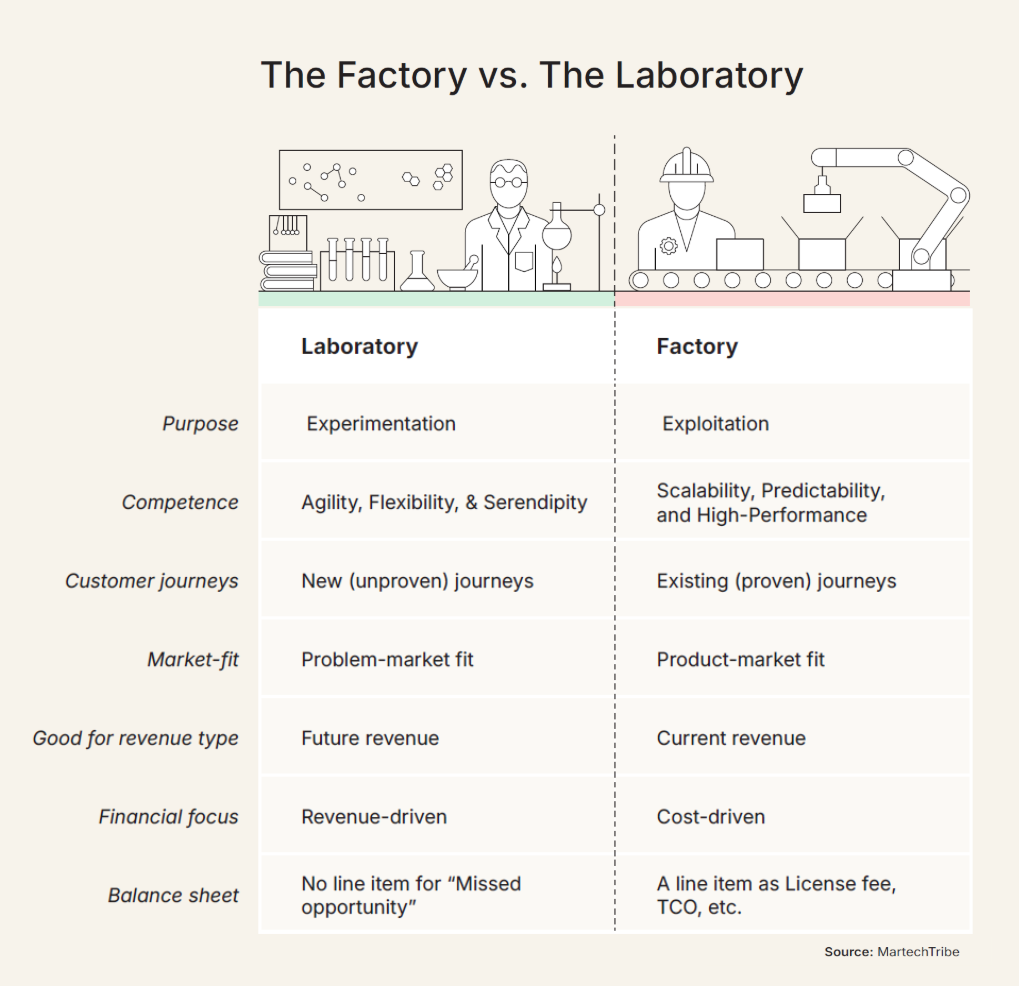
Stages 1 and 2 of AI value are factory work. Current revenue, cost-driven, measurable. Stages 3 and 4 are laboratory work. Future revenue, revenue-driven, discoverable only through experimentation. Most boardrooms fund the factory and starve the laboratory. The efficiency gains are real and visible. The gains in effectiveness are structurally invisible until one of the many experiments succeeds.
The Conceivability Gap
Here is the part no strategy consultant will put in their deck. Stages 3 and 4 cannot be planned. They must be discovered through experimentation. Your company laboratory, often run by marketing, becomes the driver of effectiveness.
The Wright brothers flew at Kitty Hawk in December 1903. Twelve seconds. 37 metres. In that moment, Orville Wright could not conceive of airports. Not because he lacked imagination. Because airports are a second-order consequence of flight becoming infrastructure, and that infrastructure didn't exist yet. You cannot derive the airport from the aircraft. You can only find it after you have made flying possible.
Photography arrived in the 1840s as an existential threat to painting. The rational prediction: painting dies. What actually happened was the opposite. Freed from the obligation to portray people and landscapes accurately, painters invented Impressionism, Cubism, and Surrealism. An explosion of human creativity. None of it was conceivable from inside the portrait studio in 1839. The technology had to run first. Then the new proposition revealed itself.
This is the conceivability gap. It is not rhetorical. It is structural. Economists classify AI as a General Purpose Technology, the same category as electricity and the internet. Macro-economic impact always arrives through the complementary ecosystem layer, not the core technology (Brookings, 2025). The ecosystem that will define the next decade does not exist yet. It will be built by people who stopped defending predictions and started following signals.
Three Experiments, Three Revelations
Pieter Levels launched 12 startups in 12 months back in 2014. Not because he knew which would work. Because he knew the only way to find out was to ship. 40-plus projects later, 4 succeeded. Those 4 now generate over $250,000 per month combined. No employees, no venture capital, no roadmap. The lesson is not "be a solo founder." It is the mathematics of deliberate experimentation. A 10% hit rate at volume beats a 0% hit rate from prediction every time.
OpenAI launched Instant Checkout in September 2025, purchasing integrated directly with Stripe, Shopify, and Etsy. Six months later, it was discontinued. Users researched products inside ChatGPT but did not complete purchases. The last step, the actual transaction, consistently broke down. The product that replaced it routes users back to the retailer’s own website to finish. The experiment was not wasted. But if one of the pioneers of the GenAI space also struggles to find new value propositions, then it is game on for experimentation.
IKEA deployed Billie in 2021 to handle customer service. It resolved 47% of all customer enquiries, 3.2 million interactions. Costs dropped. Classic Stage 1 outcome. But 53% of enquiries were questions Billie couldn’t answer. "How do I make my apartment feel at home?" "Help me design a living room that feels like me." The chatbot's failure boundary wasn't a bug. It was an opportunity. IKEA reskilled 8,500 call centre workers as remote interior design advisers and built an entirely new selling channel. The result: €1.3 billion in new revenue in FY22, from a channel that did not exist before the experiment ran.
IKEA did not plan a €1.3 billion business. They followed the customer signal. That is the Photography-to-Impressionism mechanism, operating inside a Swedish furniture company in 2022.
Marketing and The Four Horsemen
The conceivability gap is real. But there is a second gap, and it sits inside the org chart.
Rory Sutherland puts it bluntly: most large organisations are controlled by four departments that are disproportionately punished when things go wrong and never held responsible for missed opportunities. Finance, IT, Procurement, HR. The four horsemen, as he calls them. They can claim credit for every cost saved and escape accountability for every new market never entered. The result is an institutional bias so deep it looks like strategy.
This is why the experimentation mandate should not sit with IT or Finance. It should sit with marketing, and specifically MarketingOps. They are responsible for future revenue.
MarketingOps already works at the intersection of data, technology, customer signals, and commercial outcomes. It is the one function that can run cheap experiments quickly, read failure boundaries as market intelligence, and translate a chatbot's unanswered questions into a product brief. The IKEA signal did not surface in a boardroom. It surfaced in a customer interaction log. The people equipped to read that log, and bold enough to act on it, are in marketing.
The One Question
Your organisation is probably in Stages 1 or 2, and the four Horsemen are pleasing the shareholders. The efficiency wave is the necessary precondition for going further, but only if you are watching for the signal while it runs.
Stage 4 AI value cannot be planned. It must be discovered through deliberate, fast, cheap experimentation at volume. The organisations that will own it are not the ones with the best AI idea roadmap. They are the ones building the muscle to experiment at volume, kill fast, and follow the signal when the inconceivable proposition surfaces.
The airport doesn't appear on the blueprint. Nor do airliners and their stewards, let alone the caterers. It appears after the first flights. What signals is your organisation currently ignoring?

Related posts
Keep reading for more marketing technology information!
The Retail Stack Growth Path: Sell, Orchestrate, Monetize
Why Your Marketing Budget Gets Cut. Every Time.

Marketing Is The Company's Edge: Where Value Happens