
Airline Martech has one structural blind spot with a lot of consequences. Airlines try three fixes that do not do the trick. They mainly built technology to sell the seat. Fair enough. Then they added technology to acquire the passenger. They built loyalty to make the passenger return. But many never built the technology layer that manages the customer relationship in between.
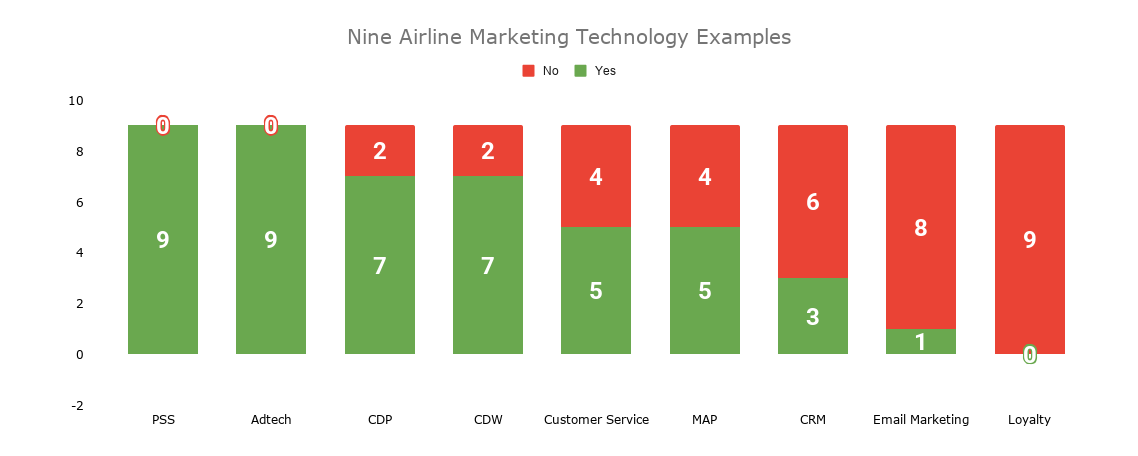
As a result, airline technology stacks are acquisition-heavy and relationship-light. Advertising and social technology are deeply embedded, while CRM, email, marketing automation, loyalty, and customer service are largely disconnected.
For a client project, we assessed nine airlines. We stumbled upon one pattern: sophisticated acquisition technology, absent relationship infrastructure, and the Passenger Service System (PSS) quietly doing a job it was never designed to do, but does anyway. A small sample, not a census, but a loud enough pattern to write about.
We looked at the stacks of Finnair, SAS, Lufthansa, Norwegian, airBaltic, JAL, Emirates, KLM, and United Airlines. The most compelling story is told by the nine categories below.
Airlines Built Their Technology Around The Transaction
Airlines have spent decades getting very good at one thing: selling seats. That makes perfect sense. It is their core business. It is at the heart of where the money is made in this industry. Getting it right was complex enough. No debate there.
The Passenger Service System (PSS) sits at the heart of that business-critical airline process. Platforms such as Amadeus, Sabre, SIRAX/RA and Navitaire manage the processes required to turn demand into passengers: reservations, inventory, ticketing and other essential transactions.
That transactional backbone became the center of gravity for technology investment. Like a Martech archaeological artefact, the stacks reveal the consequences of the (implicit) decision. Our analysis shows a recurring pattern: CRM is largely absent across the board.
The PSS is hiding that gap. Most of the activated customer data sits in the PSS. It knows who booked, where they are flying, and what they purchased. From an airline perspective, it can therefore feel remarkably like a CRM. It is Customer Relationship data after all, right? Wrong. From a Marketing technology perspective, a CRM does so much more. At best, a PSS platform effectively acts as a transactional CRM, not a marketing CRM.
PSS ≠ CRM. Not the CRM we know in Martech.
The distinctions may be subtle, but gigantic for the customer experience and retention. And they shape the entire technology architecture. When the booking is complete, the PSS has largely accomplished what it was designed to do. For the customer, however, the relationship has only just begun.
It looks like the airlines over-index on ticketing and PSS. In optimizing the transaction, customer relationship technology became secondary. And they haven’t been blind to that. They somehow noticed and came up with a remedy, albeit a quick fix.
1. The First Quick Fix: Build The Acquisition Machine
Once airlines had optimized the transaction, the next challenge was obvious: how do we get more people into the booking engine? Adtech offered the quickest answer. Marketing was reduced to performance marketing.
We know from our Apex research that Programmatic Ads is a kick-starter for getting the word out about a brand or product, but it is not a moat. Once a brand is established, as many airlines are, the focus should shift to earned, shared, and owned media, such as social media, websites, and apps. Yet airlines continue to use Programmatic Ads as a moat. An expensive solution.
The logic makes perfect sense, except it is solving the symptom, not the root cause. It created another problem: customer Groundhog Day. In marketing terms, the people entering the plane went straight for the back door.
The pattern became
● Acquire the customer.
● Convert the customer.
● Lose the customer.
● Acquire the customer again.
The evidence is clear: across the airline stacks, advertising is one of the most developed parts of the technology landscape. Search & Social Ads has 115% adoption among outperformers, meaning they use more than one tool in the category on average. Programmatic Ads alone reaches 73% adoption. One of the highest across many industries.
The technology at the front door became better and better at bringing people in, while the back door remained open. More acquisition technology could improve how efficiently airlines found and converted passengers, but it did little to manage what happened to the customer after the transaction.
And that matters economically. If every new booking starts with finding the customer again, acquisition technology is solving the same problem over and over. The acquisition machine created a new problem. So airlines built a second fix: loyalty.
2. The Second Quick Fix: Add Loyalty
Frequent-flyer programs gave passengers a reason to identify themselves, collect points, consolidate their travel with one airline, and come back. Instead of buying the same customer again through advertising, airlines could reward them for returning.
But look at the technology architecture, and something surprising happens.
Dedicated Loyalty & Referrals technology is largely absent from the airline Martech stacks. Yet, we all know almost every airline has a loyalty program. Certainly the nine airlines we checked. What is largely absent is a dedicated Loyalty & Referrals layer in the Martech stack. Loyalty modules in Amadeus and Sabre baked frequent-flyer programs into the operational core.
They solved retention as a transaction problem, not a relationship problem.
In other words, loyalty helped airlines recognize and reward returning passengers, but it did not necessarily build the missing customer lifecycle, let alone an experience or even a relationship.
This is the Groundhog Day Stack
- The PSS knows the passenger.
- Adtech knows the prospect.
- Loyalty knows the member.
No one knows the customer.
Three separate views on the customer, but no connective tissue. That connective tissue is exactly where the benchmark shows recurring gaps. CRM is absent in several airline stacks. Loyalty therefore did not close the loop, let alone close the back door. In fact, it creates more of the wrong kind of customer experiences and engagement. Ready for the third quick fix?
3. The Third Quick Fix: Customer Service Picks Up The Pieces
When acquisition and loyalty don't create a continuous customer relationship, the customer experience falls apart. And someone will have to pick up the broken pieces. And Customer Service does. It appears in 5 of the 9 airline stacks, compared with CRM in 3, Email Marketing in 1, and dedicated Loyalty technology in none.
Customer Service is different from the first two quick fixes. This fix is like a confession that the first two didn't fix the problem. Adtech gets the passenger in. Loyalty tries to bring them back. Customer Service deals with what happens when the relationship between those moments breaks down.
“I am a Gold member of an airline and have set my language preferences to Dutch and English. Yet I receive my flight confirmation emails in German. There is no way to change that.” ~ The author
The cost of the missing lifecycle doesn't disappear. It moves downstream. The third quick fix is Customer Service: fixing the customer relationship after it has already broken. So let’s fix the fix.
4. The fourth quick fix: Stitch the pieces with CDP and CDW
The fourth fix looks different. Airlines invested heavily in customer data infrastructure. Customer Data Platforms (CDP) appear in 7 of the 9 stacks. So do Cloud Data Warehouses (CDW). That is the highest adoption of any relationship category in our benchmark. Add Marketing Automation Platforms at 5 out of 9, and suddenly the architecture looks pretty sophisticated. Collect the data. Connect the data. Automate the interaction. Problem solved?
Not quite. Airlines built the infrastructure to know you, and the engine to reach you, but skipped the layer that would actually remember you.
A CDP can collect and unify customer data. A Marketing Automation Platform (MAP) can use that data to trigger messages and journeys. But without the lifecycle and relationship layer in between, those interactions remain disconnected. The messages can be personalized. The customer can still be a stranger in terms of what they need, when, and where. That is not a customer lifecycle. That is a series of well-timed interruptions.
It looks like a CDP + MAP without CRM is sophisticated-looking amnesia. Airlines built the pipes and the engine, but skipped the brain. The CDP collects the data. The MAP fires the messages. But without CRM as the connective tissue, every interaction risks starting from zero.
The structural blind spot: PSS ≠ CRM
All these fixes point to the same structural problem. Airlines have customer data, but they are not managing the customer relationship. The PSS can create the illusion that they do. It knows the passenger, the booking, and the transaction. Add loyalty, and the airline knows even more about that passenger.
We have to interpret the graph in the introduction carefully. Email at 1 out of 9 does not mean airlines don't send email. Loyalty at zero does not mean frequent-flyer programs don't exist. Every passenger receives booking confirmations, disruption alerts, and promotional messages. Most collect miles. But those capabilities run through the PSS, an operational system pressed into marketing duty. It is the tractor on the highway. It gets you there. It was never built for it.
The PSS became the default system of record not by design, but because it held the data. Data custody is not a marketing capability. But storing customer data is not the same as managing the customer relationship.
Customer Data ≠ Customer Relationship
Our benchmark makes that distinction visible. CRM is completely absent in several of the airline stacks. The report identifies this as a “structural blind spot”: PSS platforms such as Amadeus, Sabre, and Navitaire effectively act as transactional CRMs, but are not marketing CRMs.
And you can see the consequences downstream in email. Airlines do have email technology, but maturity is uneven and structural gaps remain. The pipes exist, but the customer relationship layer feeding them is weak. Without lifecycle management, the customer relationship remains fragmented. A data activation layer needs to define who the customer is, where they are in the lifecycle, and what should happen next. Without that context, email easily becomes campaigns, confirmations, and newsletters rather than continuous customer conversations.
So the email gap may not primarily be an email problem. It is a symptom of a fragmented customer lifecycle.
The same pattern appears in marketing automation. Five of the nine airlines have MAP technology, but fewer have CRM. MAP without CRM is automation without memory. It can trigger the right message at the right moment. It cannot know where the customer actually is in their relationship with the airline. The flows run. The lifecycle doesn't. MAP orchestrates the moments. CRM connects them into a lifecycle. Five airlines have the former. Three have the latter.
That brings the entire architecture together:
● The PSS manages the transaction.
● Adtech acquires the passenger.
● Loyalty rewards the passenger.
● Customer Service picks up the pieces.
● MAP orchestrates only moments.
● CRM + Activation connects the relationship.
Without that connective layer, acquisition, loyalty, email, automation, and audience activation remain separate pieces rather than one customer lifecycle. The fix is not another quick fix. It is building what was never there: the connective layer that turns transactions into relationships.

Related posts
Keep reading for more marketing technology information!
How AI Changes Composability
There Is No Best-In-Class Technology. It’s Official.
Service-as-a-Software: Scale Services Like Software with AI