
AI isn't replacing composability. It is exposing its next frontier. We used to compose software. Now we're beginning to compose intelligence. And ultimately org structures.
Composability is the LEGO of technology. It enables marketing teams to create capabilities around the customer experience. That sounds like a subtle thing, but it fundamentally changes the role of the Martech stack. AI pushes composability to its next logical step.
We started by composing software. Now we're learning to compose intelligence. That changes not only the architecture of the Martech stack but also the role of SaaS and, eventually, the organization itself.
I thought composability was about software?
It still is. But AI is expanding what we can compose. For more than a decade, composability has been about breaking monolithic software suites into interchangeable applications, APIs, and services. Instead of buying one platform that promised to do everything, organizations assembled best-of-breed capabilities that could evolve over time. The goal was flexibility: swap a CMS, replace a CDP, or add a new personalization engine without rebuilding the entire stack.
That architectural shift is far from over. In fact, AI is accelerating it. Technology is further atomizing.
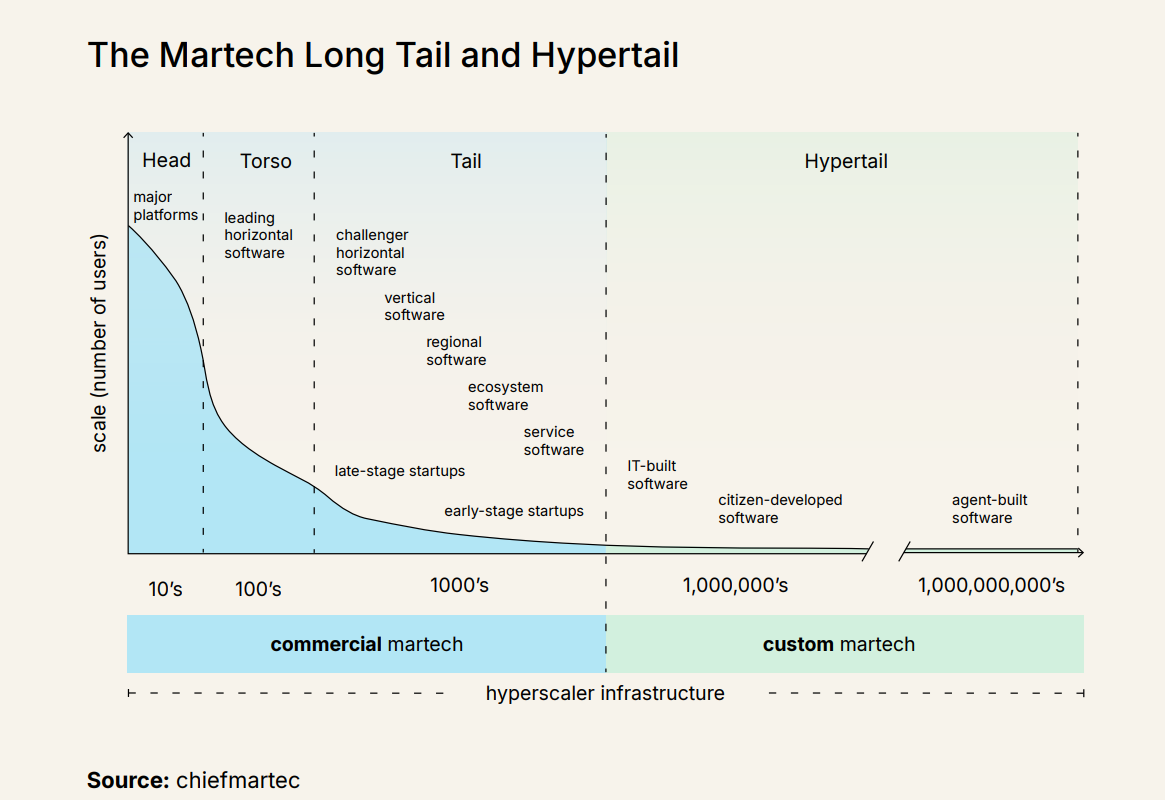
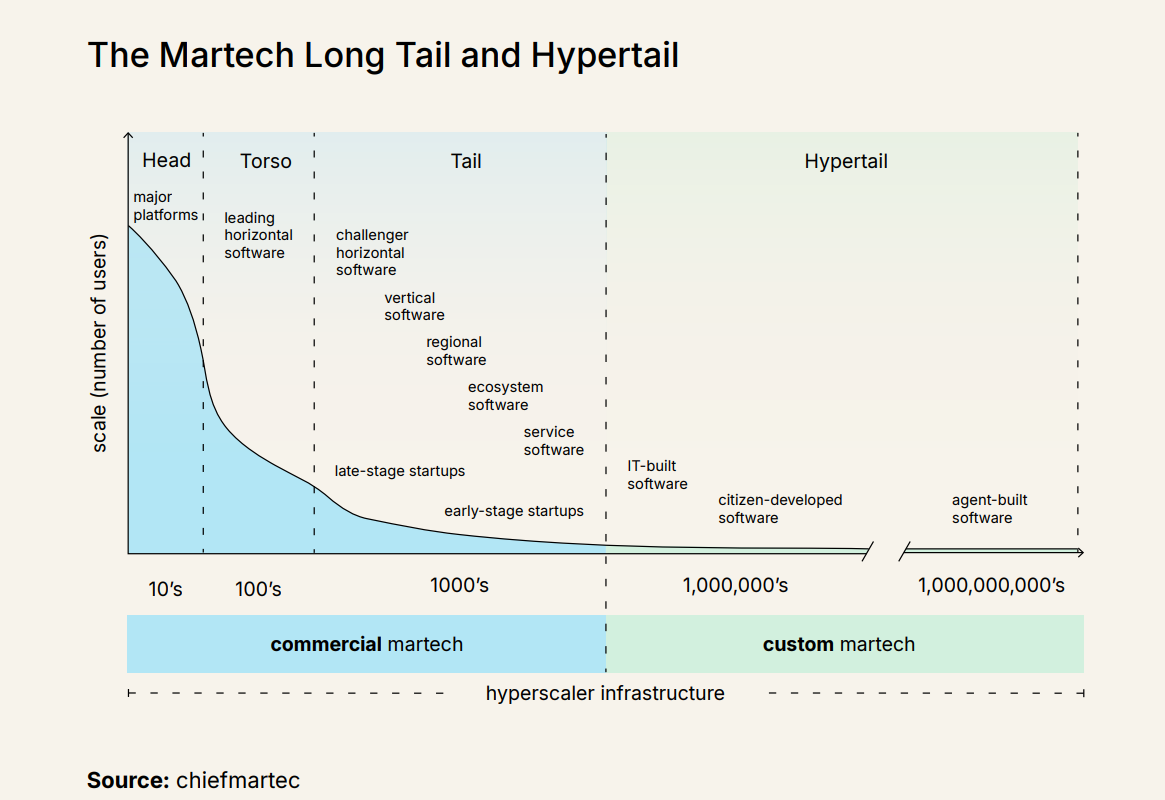
The Martech Landscape now contains 15,505 commercial products. Yet at the same time, it is becoming increasingly practical for organizations to build their own applications, the so-called Hypertail. The Hypertail consists of custom-built low-code automations and AI agents built on top of open platforms. The building blocks are becoming smaller, more specialized, and easier to compose.
The market is already moving in that direction. McKinsey reports that 23% of organizations are scaling at least one agentic AI system, while another 39% are actively experimenting with AI agents. AI is quickly becoming another building block in the enterprise architecture.
We're still in the early stages. Most organizations are experimenting with individual agents rather than composing enterprise-wide agentic systems. But the direction is becoming increasingly clear. APIs made software composable. Emerging protocols such as MCP are beginning to play a similar role for AI by standardizing how agents connect to tools and data. AI is expanding composability beyond software by introducing intelligent capabilities as a new generation of building blocks.
AI doesn't replace composability. It expands what can be composed.
So what exactly are we composing now?
Not just applications. Also Intelligence. Traditional composable stacks connected software that executed predefined tasks. CRM stored customer data, the MAP orchestrated campaigns, and Analytics measured the results. Each application performed a well-defined function within a larger workflow.
AI introduces a different kind of building block.
Instead of composing software functions, organizations are increasingly composing intelligent capabilities. Research Agents, Content Agents, Customer Service Agents, Decision Agents, and Shopping Agents don't simply execute instructions; they reason, plan, and collaborate to achieve an outcome. The unit of composition is shifting from applications to intelligence.
Our AI & Data in Marketing Survey shows this shift is already underway. 90.3% of respondents report using AI agents somewhere in their Martech stack, while organizations are experimenting with an average of 6.67 different agent types. Rather than replacing existing applications, companies are adding a new layer of intelligent capabilities that can be orchestrated alongside traditional SaaS.
Gartner predicts that 40% of enterprise applications will incorporate task-specific AI agents by 2026, up from less than 5% today. Agents are rapidly becoming a standard architectural building block rather than a standalone experiment.
AI doesn't change why we compose. It changes what we compose.
Does that mean AI replaces SaaS?
AI isn't replacing SaaS. It is redefining its role. SaaS becomes the foundation. With AI dominating the headlines, it's tempting to think enterprise software is becoming obsolete. Our research suggests the opposite.
Historically, SaaS applications were expected to do everything: store customer data, automate workflows, execute business logic, and increasingly even generate content and messaging. AI changes that division of labor.
Our AI & Data in Marketing Survey shows that 85.4% of organizations use AI to enhance existing Martech functionality, while 42.7% implement entirely new capabilities. Only 30.1% report using AI to replace existing SaaS functionality. The dominant pattern is therefore not replacement, but augmentation.
This makes architectural sense. SaaS becomes the deterministic foundation of the enterprise. It manages customer records, permissions, transactions, workflows, and business rules—processes that need to be reliable, repeatable, and auditable.
AI adds a probabilistic layer on top, interpreting context, reasoning across information, and recommending or executing the next best action. One provides consistency; the other provides adaptability.
- SaaS stores what the business knows.
- AI reasons about what the business should do next.
That architecture is still maturing. Most organizations embed AI into existing SaaS platforms or workflows, rather than redesigning their stack around autonomous agents. Hybrid architectures, where deterministic systems provide the context guardrails and AI provides the intelligence, are proving to be the practical path forward.
The future Martech stack isn't AI or SaaS. It's deterministic SaaS with probabilistic AI on top. SaaS remembers. AI reasons.
If the stack changes... does the organization change too?
Organizations become composable as well. Composability began as a software architecture principle. AI is extending it into the organization itself.
As intelligent capabilities become modular, teams become more modular too. Marketing leaders won't simply manage people or software anymore. Increasingly, they'll orchestrate teams consisting of human specialists, SaaS platforms, and AI agents. Instead of assigning work to fixed departments, they'll assemble the right combination of capabilities to achieve a business outcome.
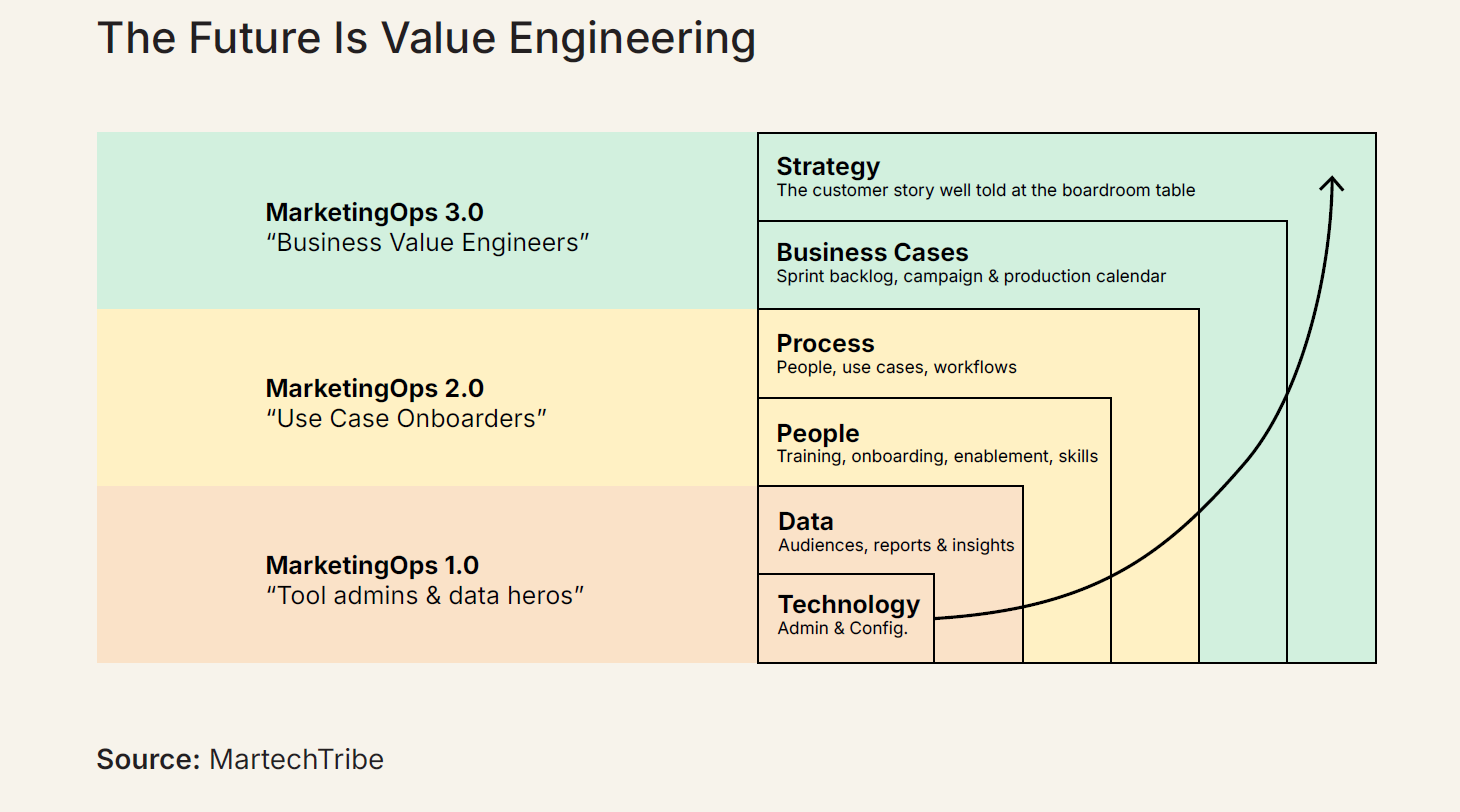
We're already seeing this shift within Marketing Operations. The role is evolving from managing technology to orchestrating value. The traditional MarketingOps professional focused on administering tools and supporting users. Today's leading teams increasingly orchestrate use cases across people, technology, data, and AI. The evolution is moving from Tool Administrator to Use Case Onboarder to Business Value Engineer.
That future won't arrive overnight. Despite the hype around autonomous AI agents, trust remains the biggest barrier. Recent HBR Analytic Services research found that only 6% of organizations fully trust AI agents to autonomously run core business processes.
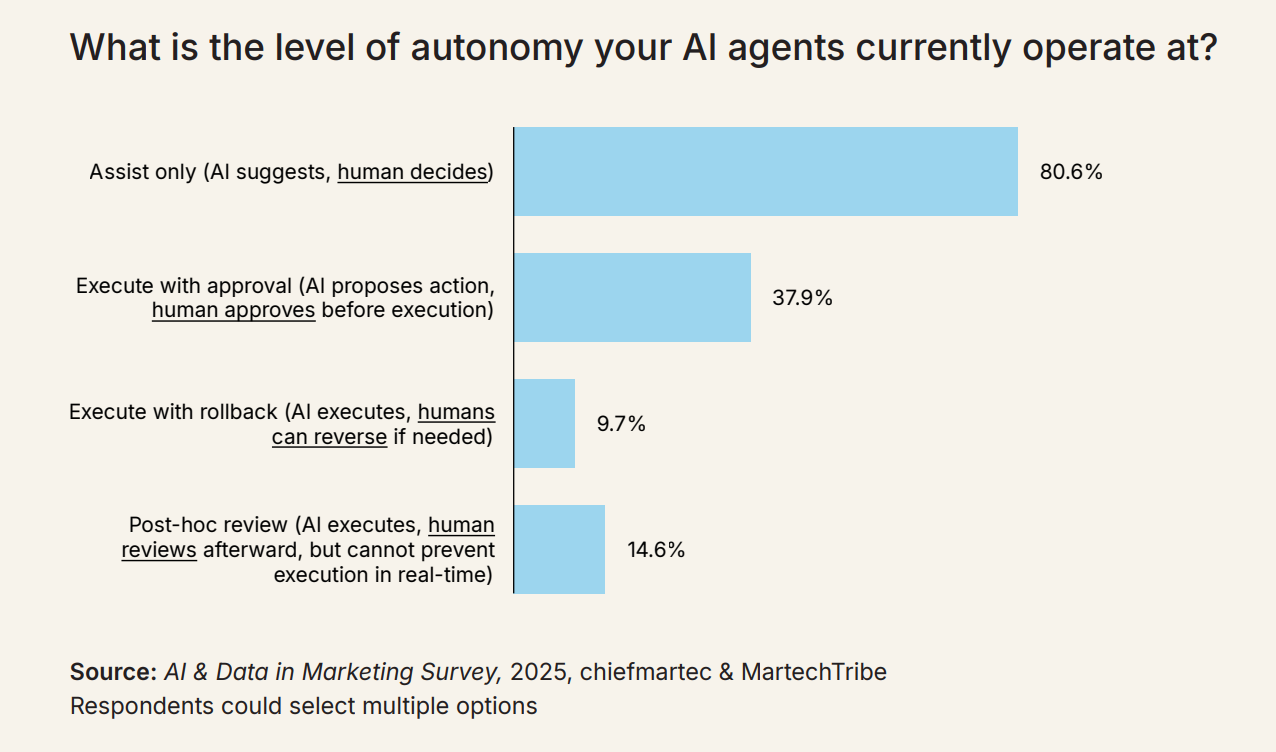
Our own research shows that it might not be a trust issue; it is showing how AI is redefining our role. Today, 80.6% of AI agents operate in an "assist only" mode, where AI makes recommendations and humans make the final decision. Another 37.9% execute tasks only after human approval. Fully autonomous operation remains the exception: just 9.7% of organizations allow AI agents to execute with rollback mechanisms, while 14.6% rely on post-hoc human review.
Rather than eliminating managers, AI is changing what they manage. This is exactly why Harvard Business Review argues that organizations need Agent Managers: people who monitor, evaluate, coach, and continuously improve teams of AI agents, much as they manage human teams today.
Closing thought
Composability began as a software architecture principle. AI is turning it into an operating model.
- Yesterday we composed applications.
- Today we compose intelligence.
- Tomorrow we'll compose skills & organizations.
For the foreseeable future, human judgment remains an essential part of the equation. AI changes how work is organized, not who remains accountable for it. The next composable system isn't the Martech stack. It's the human-agent organization built on top of it.

Related posts
Keep reading for more marketing technology information!
The Retail Stack Growth Path: Sell, Orchestrate, Monetize

Why Your Marketing Budget Gets Cut. Every Time.

Marketing Is The Company's Edge: Where Value Happens