
With AI, making the right technology decisions fast is a true competitive advantage. For more than two decades, purchasing Martech has largely meant more. More tools, more features, more integrations, and greater maturity. But our analysis of 953 real-world Martech stacks suggests that more isn't necessarily better. In some categories, industry outperformers actually invest less in technology, maturity, or both.
More importantly, the same Martech investment can be associated with industry outperformance in one industry, but have the opposite effect in another. What distinguishes outperformers in one industry may simply not distinguish them in another. For brands, the cost of copying the wrong investment pattern can be substantial.
Take Marketing Automation Platforms (MAP). Across all seven industries we investigated, outperformers use broader MAP functionality. But maturity tells a different story. In six of seven industries, outperformers run less mature MAP deployments than lower performers, most sharply in BFSI. In Telecommunications, the signal reverses: outperformers are more mature.
Same technology category. Different investment pattern. There is no one-size-fits-all formula for how much technology or maturity is enough.
The difference isn't how much technology companies have. It's how well their technology investments align with the business. The Martech era of “More Martech” is giving way to the era of “Aligned Martech.”
AI Exposes Your Technology Foundation
Many organizations assume AI will replace software. Our research shows the opposite. Today, 85% of organizations use AI to enhance their existing technology stack with entirely new functionality and use cases, while only 30% (page 9) use AI to replace parts of existing SaaS functionality.
AI is not removing the technology foundation. It is building on it.
Enterprise software increasingly provides the deterministic infrastructure layer: data, business logic, workflows, governance, security and integrations. AI and agents add a probabilistic value layer on top, bringing reasoning, personalization and autonomous decision-making.
AI can only work with the foundation underneath it. A well-aligned stack gives AI more to build on. A poorly aligned stack gives it more problems to amplify. The conclusion must be: AI won't save a broken technology stack. It will expose it.
Also, that makes technology investment decisions more important, not less.
We Still Buy Technology Like It's 2005
While the technology architecture has fundamentally changed, the way we buy technology hasn't.
For more than two decades, Martech decisions have been dominated by the Technology Lens. Analyst reports, RFPs, feature comparisons, vendor demonstrations, and best-in-class rankings all ask essentially the same question: Which software is best? The underlying assumption is that the best-engineered platform, with the richest feature set, will create the most business value.
The result is familiar to all practitioners: “We bought a Ferrari, but only needed a Ford.”
The problem isn't the Ferrari. The Technology Lens is amazing, but it is only one end of the stick. The problem is the assumption that better technology automatically produces better business outcomes. That is the other end of the stick, the Business Lens. Instead of asking which technology has the most features, ask which capabilities create value for the business and its customers. Instead of optimizing for technology coverage, optimize for business outcomes.
Source: MartechTribe
Technology and business are two ends of the same stick. Yet we have spent decades optimizing one end and assuming value would appear at the other.
AI makes that assumption increasingly expensive.
There Is No Best-In-Class. Only Best-Aligned.
So, does better technology actually produce better business outcomes?
To find out, we analyzed 953 real-world Martech stacks across seven industries, measuring approximately 1,300 features across 49 Martech categories, together with Martech maturity: the people, processes, and skills required to turn technology into value.
We then compared the investment patterns of revenue outperformers, the top 30% in Revenue per Employee within each industry, with lower-performing organizations.
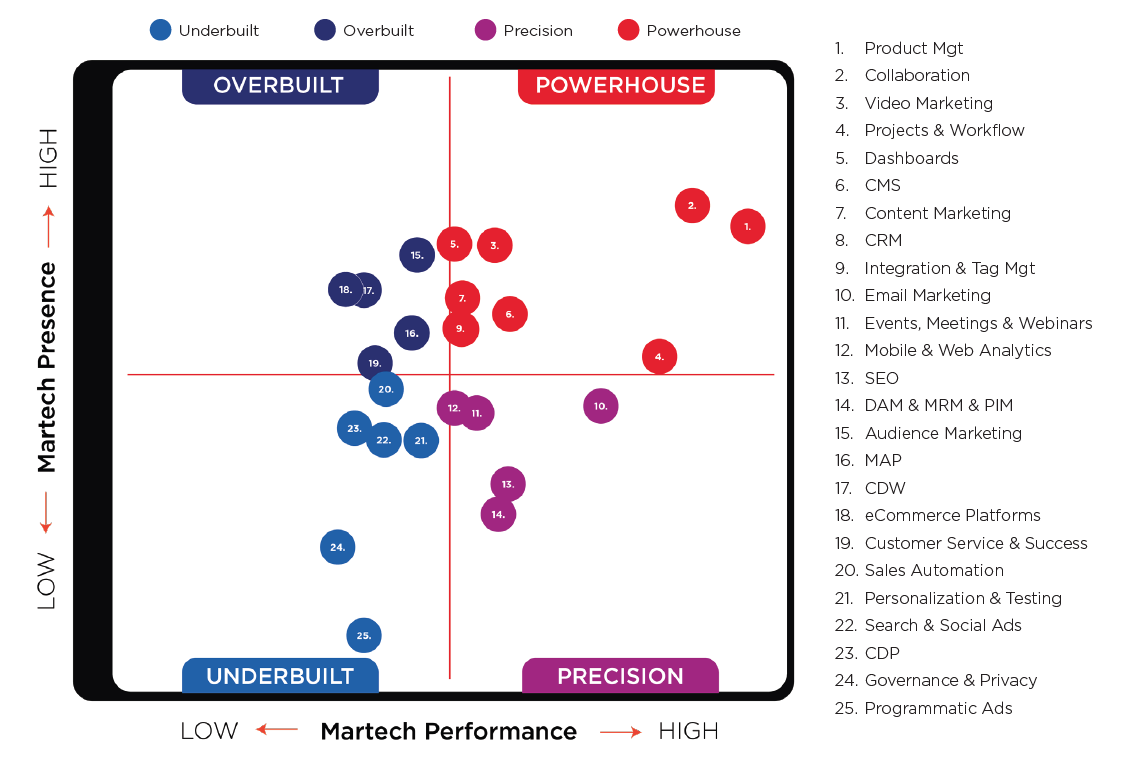
Source: MartechTribe Martech, Investment patterns.
If broader functionality consistently distinguished outperformers from lower-performing organizations, every bubble would appear on the right side of the chart. If Martech maturity consistently distinguished them, every bubble would appear in the upper half. If both consistently mattered, every bubble would cluster in the upper-right corner.
They don't. The bubbles appear in every quadrant.
Across the 49 categories, we found four distinct patterns. Sometimes features distinguish outperformers. Sometimes maturity does. Sometimes both do. And sometimes, perhaps most surprisingly, outperformers invest less in both.
The same technology investment can therefore be associated with outperformance in one industry, but not in another. There is no universally best feature set, maturity level, tool, or Martech stack. There is only best-aligned technology for a specific business context: industry, business model, and company size.
Four Ways Technology Creates Value. Or Doesn't.
The four investment patterns become clearer when looking at individual Martech categories.
1. When features close the gap. Marketing Automation Platforms (MAP) are one of the clearest examples. Across all seven industries, outperformers consistently use broader functionality than lower-performing organizations. Yet in six of seven industries, their Martech maturity is lower or equal. Here, competitive advantage comes from having more sophisticated capabilities available, not from building a more mature organization around them.
2. When maturity closes the gap. Email Marketing is almost the mirror image. Outperformers aren't running more sophisticated email technology; they are running it better. The advantage comes from execution: list hygiene, sender authentication, deliverability, reputation, and operational discipline. More features don't close the gap. Better execution does.
3. When both close the gap. CRM shows the more traditional pattern. In six of seven industries, outperformers combine broader functionality with higher Martech maturity. CRM has become a gateway to first-party customer data, so having the right capabilities and the organizational ability to use them reinforce each other.
4. When neither closes the gap. CDP provides perhaps the most surprising result. Across all seven industries, outperformers show both lower feature sophistication and lower Martech maturity than lower-performing organizations. But that doesn't mean CDPs don't create value. CDP appears to be a category in transition. Earlier research suggests that as Customer Data Warehouses absorb more of the data management function, CDPs are increasingly shifting toward engagement. The category is evolving, making today's investment decisions less straightforward.
The lesson isn't that features don't matter, or that maturity doesn't matter. It's that neither matters equally everywhere. The right investment lever depends on the technology category, industry, and business context.
So Where Should You Invest?
“There is no best-in-class, only best-aligned” sounds good in theory. But it leaves decision-makers with an uncomfortable answer to the question of where to invest: It depends.
So we need to define what “aligned” looks like. Not in theory, but in data.
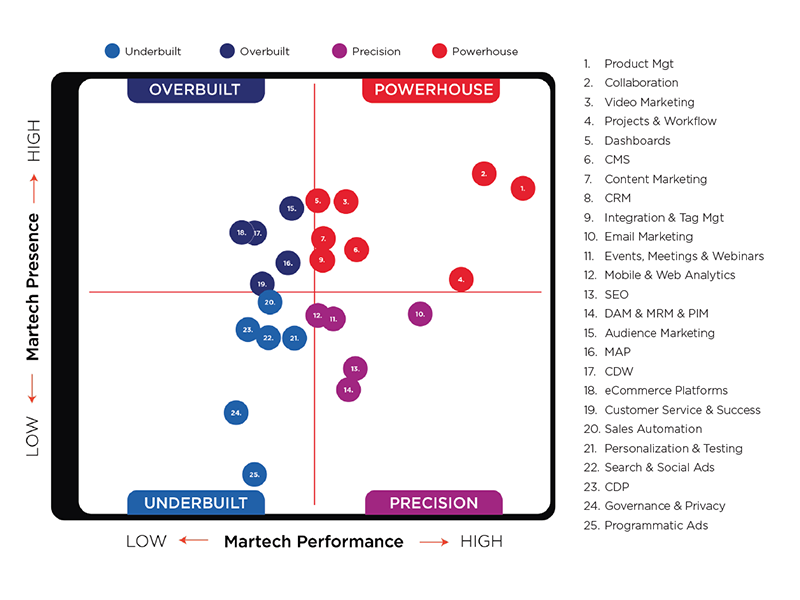
The Apex Martech Matrix does this by measuring a company's stack against the investment patterns of outperformers in its own industry. It looks at two dimensions: Martech Presence, are the right features present?, and Martech Performance, do we have the right people, processes, and skills to execute?
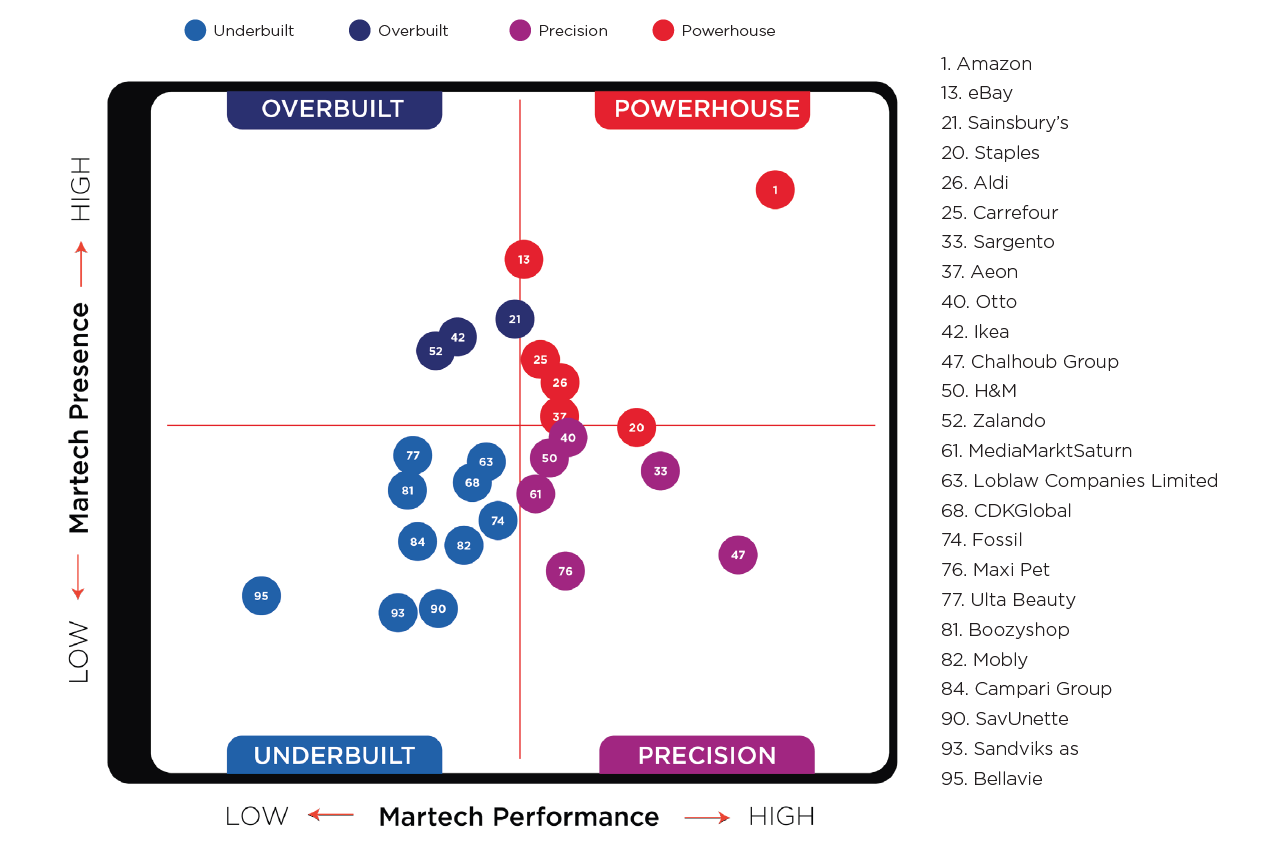
Source: The Apex Martech Matrix, developed by MartechTribe in collaboration with the CMO Council. Retail Industry example.
The Apex Martech Score then quantifies that alignment on a scale from 0 to 100. Importantly, 100 does not represent the biggest stack, the broadest feature set or the highest maturity. It represents the closest alignment with the investment patterns of industry outperformers. That is where the four investment patterns above start to pay off.
That changes the investment question.
Instead of asking “What technology should we buy next?”, organizations can ask: Which categories should we keep? And where we do invest, should we add functionality, improve maturity, or both?
The answer may even be to invest less.
The goal is no longer to build the best Martech stack. It is to build the stack that best fits the business.

Related posts
Keep reading for more marketing technology information!
The Retail Stack Growth Path: Sell, Orchestrate, Monetize

Why Your Marketing Budget Gets Cut. Every Time.

Marketing Is The Company's Edge: Where Value Happens