
Every CMO I talk to gets the same question from their team, their board, and their vendors. Will AI-native tools replace the SaaS stack? Our recent survey data says no. But it doesn’t say “nothing changes” either. Au contraire. The stack is being reshuffled. Task by task.
Scott Brinker and I asked 208 marketers how they adopted genAI across 70 marketing use cases. For each one, they told us which route they took. AI bolted onto an existing SaaS tool. A new AI-native product. Or a solution they built themselves.
No pathway wins outright. SaaS leads, but AI-native and build-your-own together account for well over half of all adoption. Lay the use cases out as a spectrum and a clear line appears. It doesn’t follow how new or hyped a use case is. It follows the nature of the task. That sounds obvious. Yet few companies make their AI choices this way.
AI-native tools aren’t replacing SaaS. They sit at the other end of the same spectrum. On one side is a deterministic layer, where AI is a feature of the workflow tool. On the other is a probabilistic layer, where AI is the tool.
1. SaaS Still Owns The Deterministic Layer
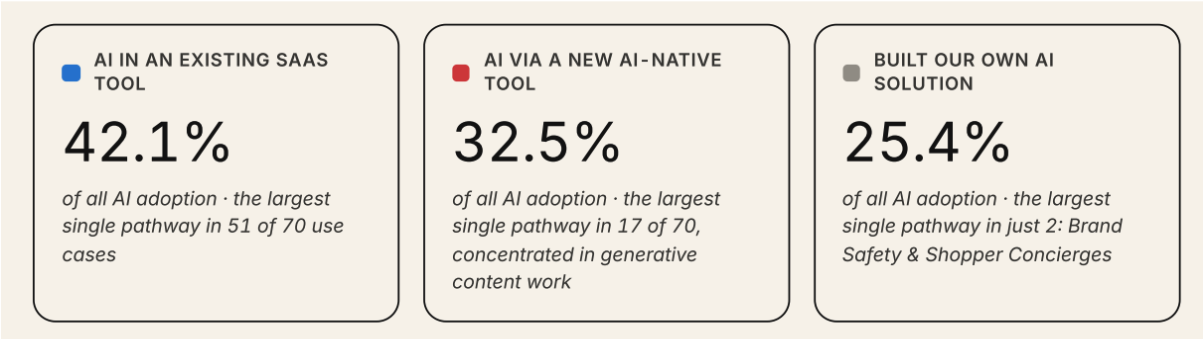
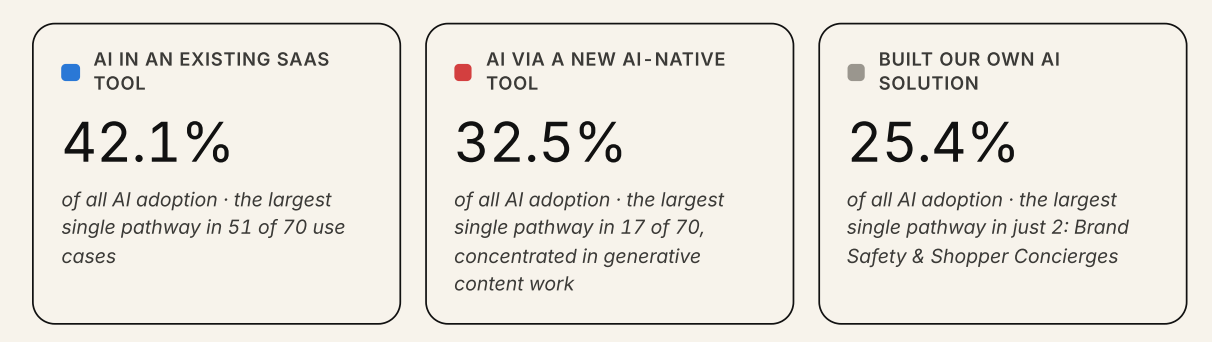
Let’s start with the biggest number. 42.1% of all AI adoption in our data runs through an existing SaaS tool. That makes it the largest single pathway in 51 of the 70 use cases.
That’s not a takeover. That’s an incumbent holding its ground.
And it holds by a wide margin. Even where AI-native tools lead, they rarely beat SaaS by more than about 15 points. Most marketers aren’t ripping out their stack to get AI. They’re switching it on inside the tools they already use.
Look at where SaaS leads, and a pattern shows up fast. Lead routing. Scheduling. Dashboards. Pipeline forecasting. Compliance. These are structured, rules-driven workflows. The output has to be right, repeatable, and auditable. A lead goes to one rep, not a creative interpretation of three reps. That’s the deterministic layer.
In the deterministic layer, AI is a feature of the workflow tool, not the tool itself.
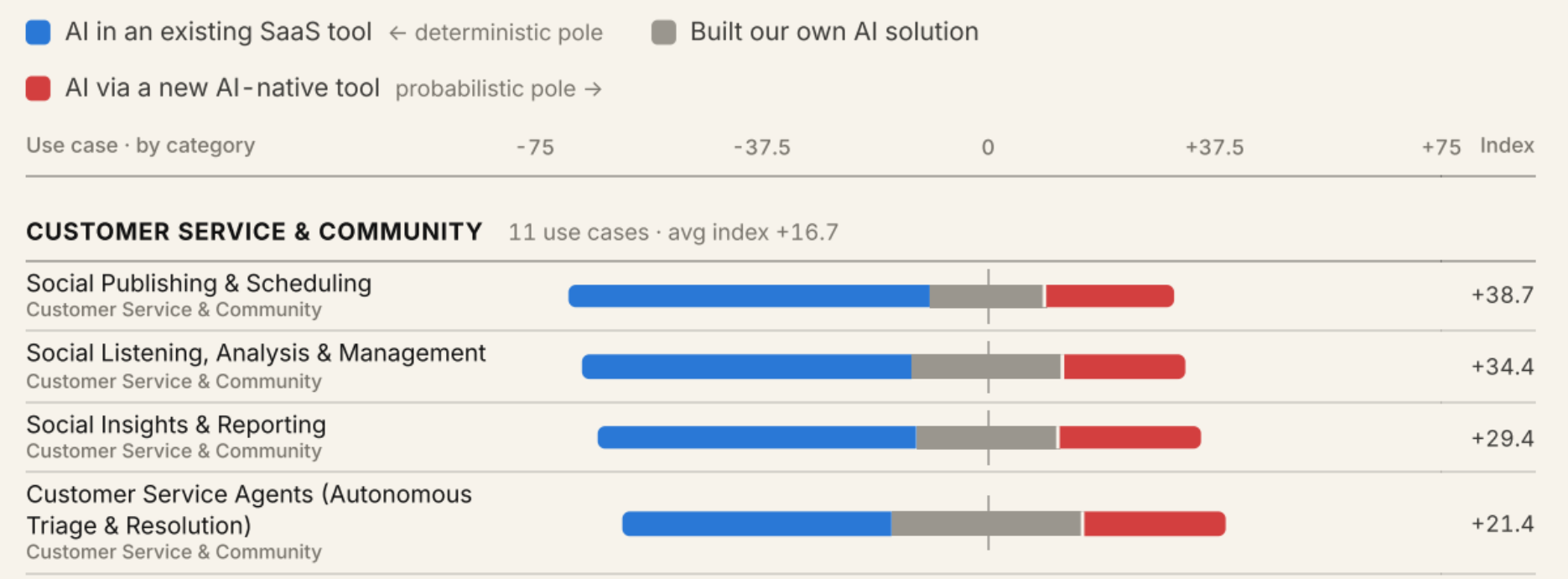
The clearest example is Social Publishing & Scheduling. It’s the most SaaS-led use case in the entire study, with an index of +38.7. That index is simply the SaaS share minus the AI-native share. Positive leans SaaS, negative leans AI-native. Nobody needs a new AI product to schedule a post. They need the scheduler they already have to get a bit smarter.
So where does the incumbent’s advantage come from? Not the model. Everyone has access to roughly the same models now. The advantage is the workflow and the data already sitting inside it. The rules, the integrations, the history, the permissions. That’s hard to move and expensive to rebuild.
This is good news for SaaS vendors, with a catch. They win this layer by being the system of record and execution. They don’t win it by being the most impressive AI. And that’s exactly why the other side of the spectrum looks so different.
2. AI-Native Wins Where The Output Is Generated
Now flip to the other pole. 32.5% of all AI adoption runs through a new AI-native tool. That’s the largest pathway in 17 of the 70 use cases. And those 17 aren’t scattered. They cluster.
Copy Ideation. Ad Copy. Visual Ideation. Coding. Internal Copywriting. Video.
All of these produce something. Words, images, code. The output is generated, not routed or calculated. There’s no single right answer, just better and worse ones. That’s the probabilistic layer. Here, AI isn’t a feature of the tool. AI is the tool.

The most extreme case sits in the chart from the previous section. Agentic Community Management is the most AI-native-led use case in the whole study, with an index of −17.9. It’s the mirror image of Social Publishing & Scheduling at the top. Same channel, completely different task.
This part is the most interesting. You’d expect AI-native tools to win where use cases are new or niche, where incumbents haven’t caught up yet. That’s not what the data shows.
Copywriting is about as mainstream as marketing gets. Every email platform, every CMS, every ad tool has bolted on a writing assistant by now. AI-native tools still lead. Narrowly, but they lead. So novelty doesn’t predict the winner. The nature of the task does.
That makes sense. A generative task lives or dies on the quality of the output. Marketers will happily open a separate tool if it writes better copy or makes a better visual. They won’t open a separate tool to schedule a post a bit faster.
For SaaS vendors, this is the uncomfortable part. A writing assistant inside the workflow is convenient. But convenience loses to quality when the output is the whole point. And then there’s a third group that chose neither.
3. Build With AI Where You Need to Differentiate
The third pathway is the smallest one, but it can’t be ignored. 25.4% of AI adoption comes from companies building their own solution. That’s a serious share. Yet building is the leading pathway in just 2 of the 70 use cases: Brand Safety and Shopper Concierges.

Those two have something in common. Both run on context that only the company has. Brand safety is about your rules, your red lines, your reputation. A generic tool doesn’t know what your brand will never say. A shopper concierge has to know your catalog, your customers, and your tone. Get it wrong, and it’s your brand on the line, not the vendor’s.
So companies build where their own context is the differentiator. Not because building is cheaper. It rarely is.
The Takeaway
Put the three pathways together, and the reshuffle becomes visible:
- SaaS defends the deterministic layer, where the workflow and the data already live.
- AI-native tools take the probabilistic layer, where the output is generated.
- Building fills the gap where neither can carry your context.
That’s the reshuffle of technology roles. Not in a vendor pitch, but in how 208 marketers actually adopted AI.
For martech leaders, this changes the buying question. Stop asking whether to go SaaS or AI. Ask whether the task is deterministic or probabilistic. Buy SaaS where the task is rule-driven. Buy AI-native where the task is generative. Build only where your own context is the asset worth protecting.
The stack isn’t being replaced. It’s being reshuffled, one task at a time.
About the data: 208 respondents, 70 marketing use cases. Shares are calculated among respondents already using AI for each use case. The data is self-reported and multi-select, so read comparisons between use cases directionally. The index (SaaS share minus AI-native share) is our analytical construct, not a survey question.

Related posts
Keep reading for more marketing technology information!
AI Isn’t Eating SaaS. It’s Splitting The Stack.
The Retail Stack Growth Path: Sell, Orchestrate, Monetize
Why Your Marketing Budget Gets Cut. Every Time.