
Retail stacks don’t grow bigger. They grow up. Retailers don’t buy a stack. They grow one. And they grow it in layers. Every stage of the business adds a new problem, and every new problem ends up in the stack. What you need at €50 million is not what you need at €1 billion annual revenue. But what you build at €50 million decides how easily you get there. There are roughly three stages.
For a large retail customer, we recently analyzed 219 retail stacks of small, medium, and large retailers to see how they evolve. The pattern is clear.
- Small retailers sell and serve.
- Medium retailers orchestrate.
- Large retailers monetize.
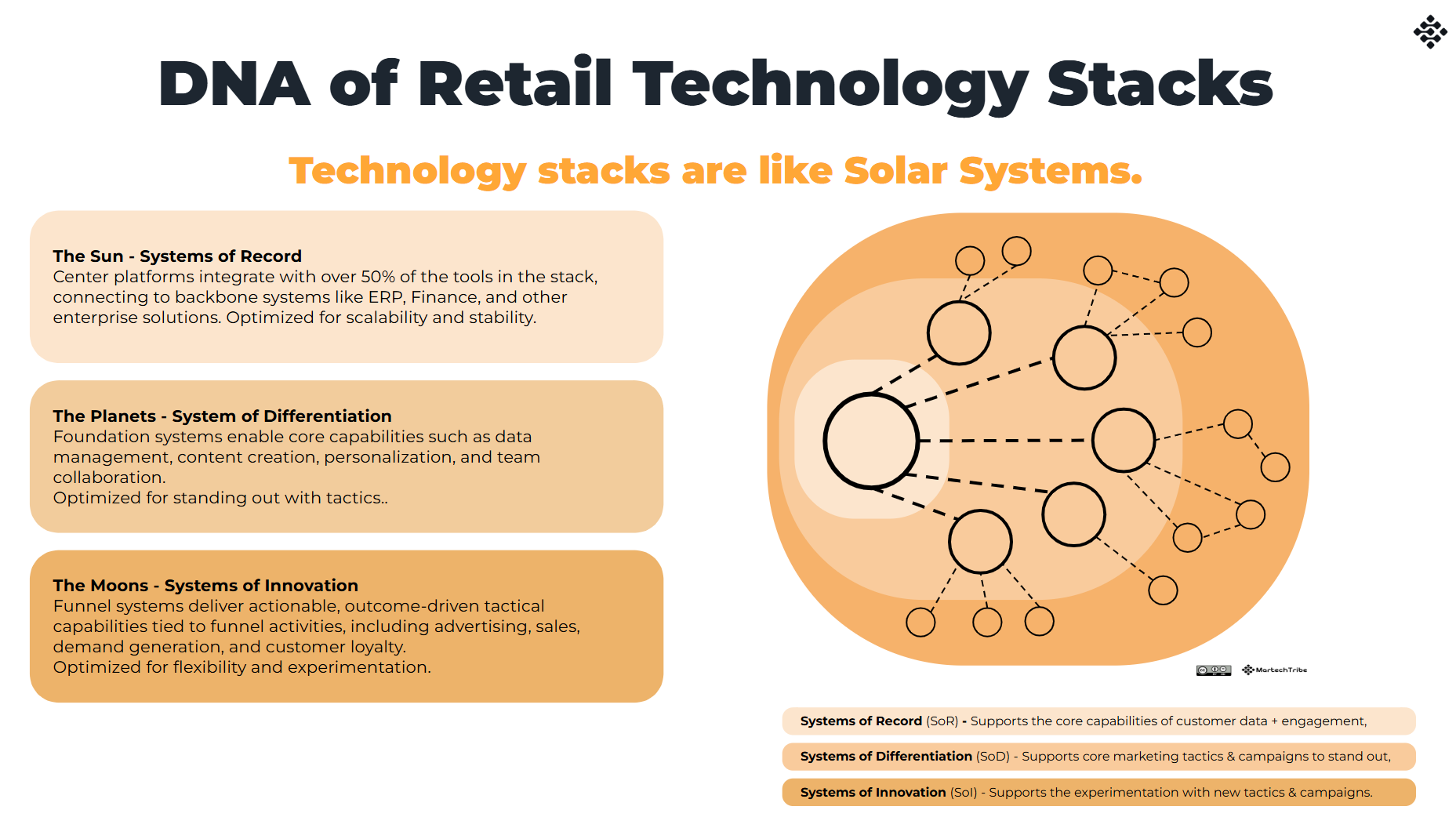
Each stage builds on the one before it. To read technology stacks, imagine a solar system.
- The sun is the Systems of Record. The center platforms that hold customer data and engagement together. They integrate with more than half of the tools in the stack and connect to the backbone of the business, like ERP and finance. Built for stability and scale.
- The planets are the Systems of Differentiation. The tools that power the marketing tactics and campaigns that make you stand out.
- The moons are the Systems of Innovation. The tools for experimenting with new tactics and campaigns. Built for flexibility.
Now the numbers. Small retail stacks (< €100 million) are about 60% the size of a large retail stack (> €1 billion). Medium stacks are at 84%. So the stack grows fastest from small to medium.
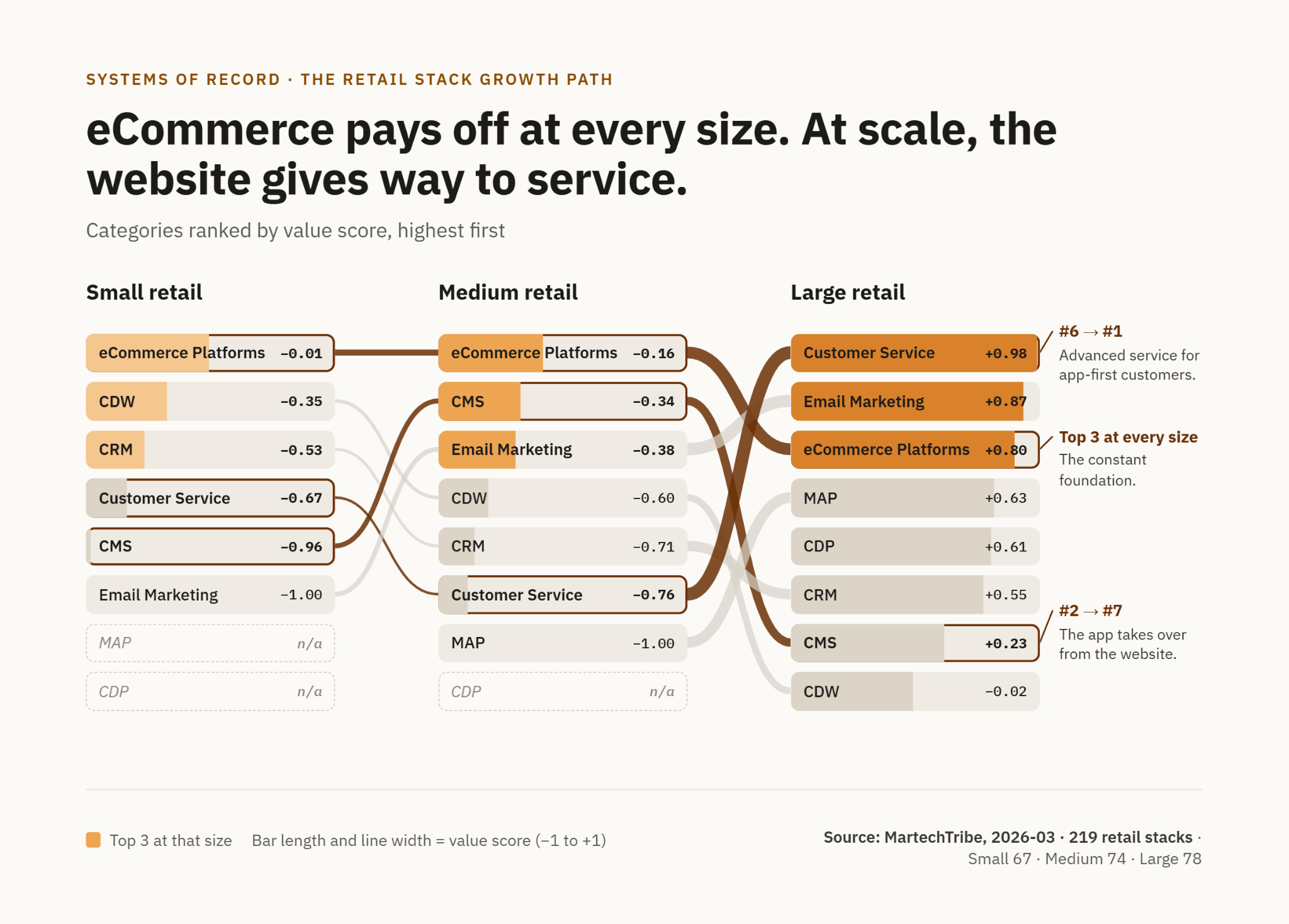
But size is not the only interesting part. Value is too. Here’s what that looks like across the three Retail company sizes. Every column ranks the categories by value, highest first. Value here means how strongly higher maturity in a category correlates with higher revenue per employee. It shows what outperformers actually do. Not what they say they do.
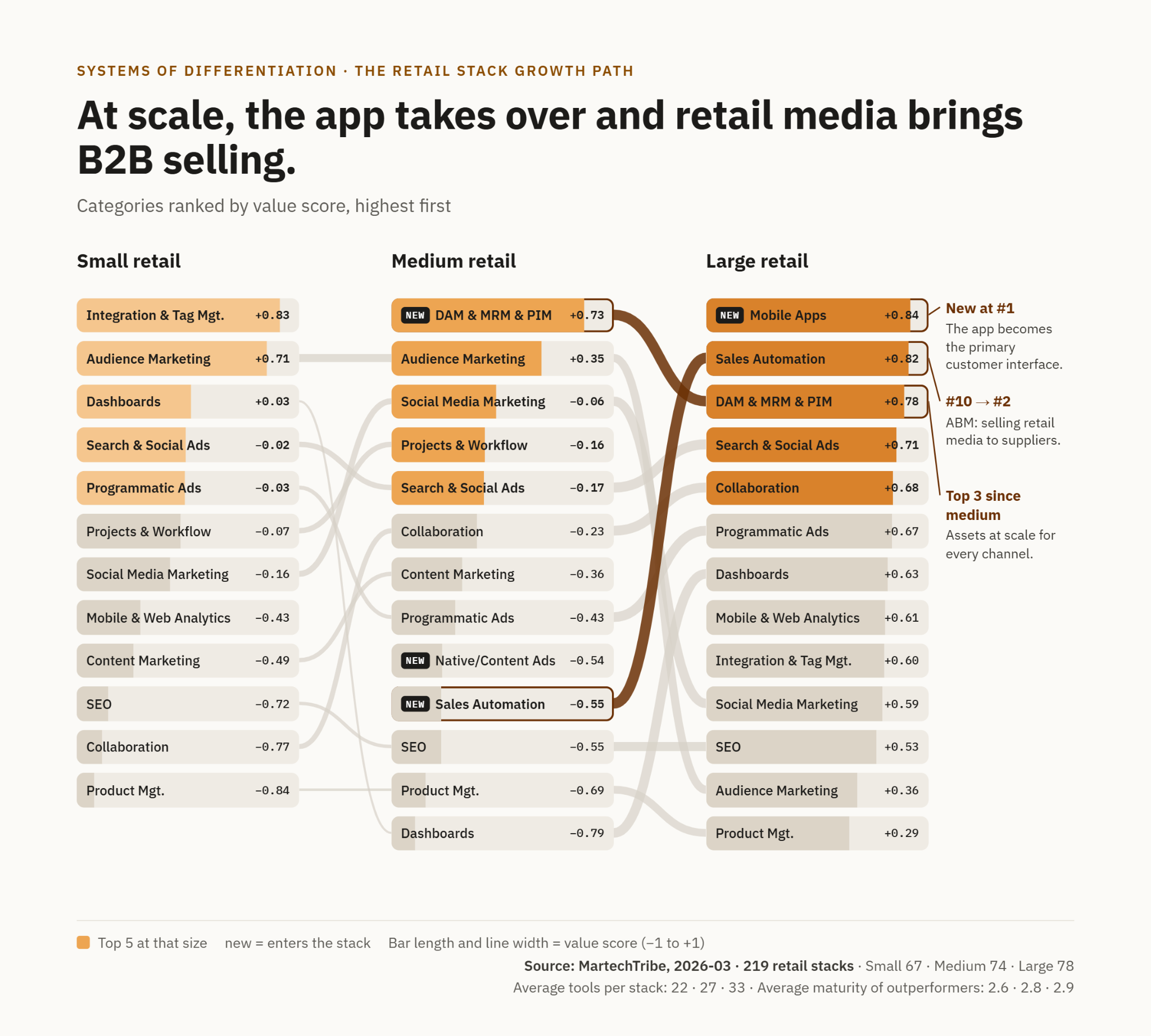
One more thing stands out. The average stack grows from 22 tools for small retailers to 33 for large ones. That’s 50% more tools. But outperformer maturity only rises from 2.6 to 2.9. Stacks get bigger much faster than they get better. And even the outperformers haven’t reached level 3, Defined, yet. There’s plenty of room at the top.
For every tool category, we scored how strongly a more mature tool goes together with better business results. A score of +1 means it clearly pays off. Zero means it makes no difference. Below zero means the retailers who invest more don’t do better for it.
Two things stand out.
- The payoff comes late. For small and medium retailers, most scores sit below zero. Only a few tools pay off. For large retailers, almost the whole stack does. The stack grows fastest from small to medium. The value shows up from medium to large.
- What pays off keeps changing. The website matters most in the middle and drops back at scale. The app comes out of nowhere and lands at the top. And a stack that was all B2C starts selling to suppliers.
Let’s walk the path.
Small Retail: Sell And Serve
Small retailers don’t have a stack problem. They have a survival problem. And their stack shows it.
The center of the Retail solar system is formed by the Systems of Record that every other tool depends on: eCommerce, CMS, CRM, and Customer service. eCommerce ranks first in value. No surprise. Selling is the business. Some basic analytics, sometimes an early data warehouse. The logic is simple. If a tool doesn’t help you sell or help you talk to your customer, it doesn’t make the cut. Complexity costs money. Overhead costs people. And small retailers have neither to spare. This is why their stacks are the smallest we see: about 60% of the size of a large retail stack.
On the marketing side, the planets are few. The Systems of Differentiation are mostly about getting seen. Search and social ads. Some programmatic. Both rank in the top five. Campaigns are small and run one at a time.
Email is there too. But it ranks last in value. Having email is not the same as getting value from it. At this stage, there isn’t enough volume or data to make it work.
Collaboration is basic. A shared drive, a project tool, a few people who know where everything is. Brand assets live wherever the last designer saved them. And investing more here doesn’t pay off yet. Collaboration ranks near the bottom.
And then there’s the data. This is where it gets interesting. The two categories that pay off most for small retailers are integration and tag management, and audience marketing. Connecting the tools. Knowing who your customers are. Pioneering. Prototyping. Finding out what works.
Many small retailers are already experimenting with a CDP or a data warehouse. Most of these experiments don’t have a clear owner yet. They don’t need one. Not yet.
Here’s the point. Keep the stack lean. That’s the right call at this stage. But don’t skip the data foundation. It’s the one investment that already pays off. And the jump to medium is the biggest one on the growth path. The data layer decides whether your stack scales with you or breaks under you.
Build it small. Build it now.
Medium Retail: From Running Channels To Orchestrating Campaigns
Medium retailers have survived. Now they want to grow. And growth changes everything about the stack.
This is the biggest jump on the growth path. Small stacks are about 60% of the size of a large retail stack. Medium stacks are already at 84%. That’s 24 points in one step, more than the entire move from medium to large.
The reason is simple. More customers, more campaigns, more channels, more people. Every one of those adds a coordination problem. And coordination problems end up in the stack.
It starts with the foundation. eCommerce still ranks first. The CMS climbs to second. The website is the front door now, and it carries more and more of the business. Email gets serious too, moving from last to third.
On the marketing side, the planets multiply. Social media marketing moves into the top three. Search and social ads stay in the top five.
But here’s the real shift.
- Small retailers run channels.
- Medium retailers orchestrate campaigns across them.
That needs structure. Workflow tools. Project coordination. And a single source of truth for brand assets. This is where DAM and PIM come in. They enter the stack at this stage and go straight to number one. The shared drive and the one designer who knows where everything is, that doesn’t scale anymore.
This is also the stage where stacks break. And the numbers show it. Apart from DAM and audience marketing, a more mature tool doesn’t pay off at this stage. The tools that worked at small scale get stretched. Integrations get patched. Data lives in too many places. Teams work around the stack instead of with it.
The retailers who built their data foundation early have it easier. Their new tools plug into something that already works. The others are rebuilding the plane while flying it.
Important advice for this stage. Stop adding tools for channels. Start investing in the layer that connects them. Integration, workflow, and assets are not overhead at this point. They are the growth path.
Large Retail: The Stack Becomes A Revenue Engine
Large retailers aren’t trying to survive. They aren’t just trying to grow either. They’re trying to scale and to turn the stack into part of the business model. A real asset.
The stack keeps getting bigger, but the growth slows down. From medium to large, it’s 16 more points, compared to 24 in the step before. And this is where the investment finally pays off. Almost every category scores above zero. The stack stops being a cost and starts working.
The foundation is fully grown. eCommerce stays in the top three, as it is at every size. The CDP now drives audiences at scale. MAP Activates messaging. DAM and MRM manage huge volumes of assets and campaigns. PIM keeps the product data in line across every channel.
The data warehouse ranks last. Not because it doesn’t matter. Every large retailer has one. By now, at this size, it’s table stakes, not a differentiator.
And then something surprising happens. The mobile app enters the stack and goes straight to number one. It becomes the main customer interface. The CMS, number two at medium, drops to seventh. The app is where the customer lives now. Customer service has to follow. It jumps from sixth to first, and it gets a lot more advanced.
On the marketing side, ads still pay off. Search and social ads stay in the top five at every size. Campaigns are big. They need planning, budgeting, and real resource management. That’s what MRM is for.
But the real story is a new revenue stream.
Large retailers turn their customer data and their reach into something they can sell. Retail media networks let suppliers buy access to the retailer’s audience. And selling to suppliers is B2B. It needs account-based marketing and its own tools. So sales automation enters a stack that used to be all B2C. It jumps from tenth to second.
This is the final shift on the growth path. Marketing stops being a cost center. The stack stops being a set of tools that support the business. It becomes a revenue engine in its own right.
Where Are You On The Path?
Every stage builds on the one before it.
- You can’t run a retail media network without a mature data backbone.
- You can’t orchestrate campaigns without integrated foundations.
- And you can’t skip the foundation at all.
The stack grows early. The value comes late. That’s no reason to wait. It’s a reason to build the right layer at the right time. So know where you are. And build the next layer before you need it.

Related posts
Keep reading for more marketing technology information!
The Retail Stack Growth Path: Sell, Orchestrate, Monetize

Why Your Marketing Budget Gets Cut. Every Time.

Marketing Is The Company's Edge: Where Value Happens