

We all know it, but we don’t do it. Start with the business outcomes. Work back to the use cases and campaigns that deliver them. Then map those to the data and systems we need.
That’s the logic. We’ve known it for decades. But it rarely happens that way. Instead, we got really good at cutting costs. No matter how much we wish it did. So why do companies keep starting with tools, costs, and licenses instead of outcomes?
Well, cost cutting is easy. While calculating revenue is 10x more complex than calculating costs. Not just a bit harder. Not just a different kind of hard. Next level harder. It’s checkers on one board versus chess on ten.
And when one side of the equation is easy, and the other is hard, the easy side quietly takes over. That’s what happened.
That matters, because finance doesn’t create value. It can’t. The best a CFO can do is protect and increase margin. Do that long enough, and you marginalize the brand (no pun intended; language got there first). Without anyone investing in what customers value, you just optimize the margin.
That’s not a criticism of CFOs. Margin is their job, and they do it well. Creating value is marketing’s job. Which means the jigsaw is ours to solve. Nobody else is going to do it. They do not know the customer.
In this article, I’ll unpack that in three steps, with a receipt and a jigsaw. Why costs and revenue are fundamentally different problems. Why that difference tilts every budget discussion toward cutting. And what marketing can do to make the revenue side count anyway. Because ROI puts both in one formula: one exact number and one judgment. The latter hopefully based on data.
Costs Are A Receipt. Revenue Is A Jigsaw.
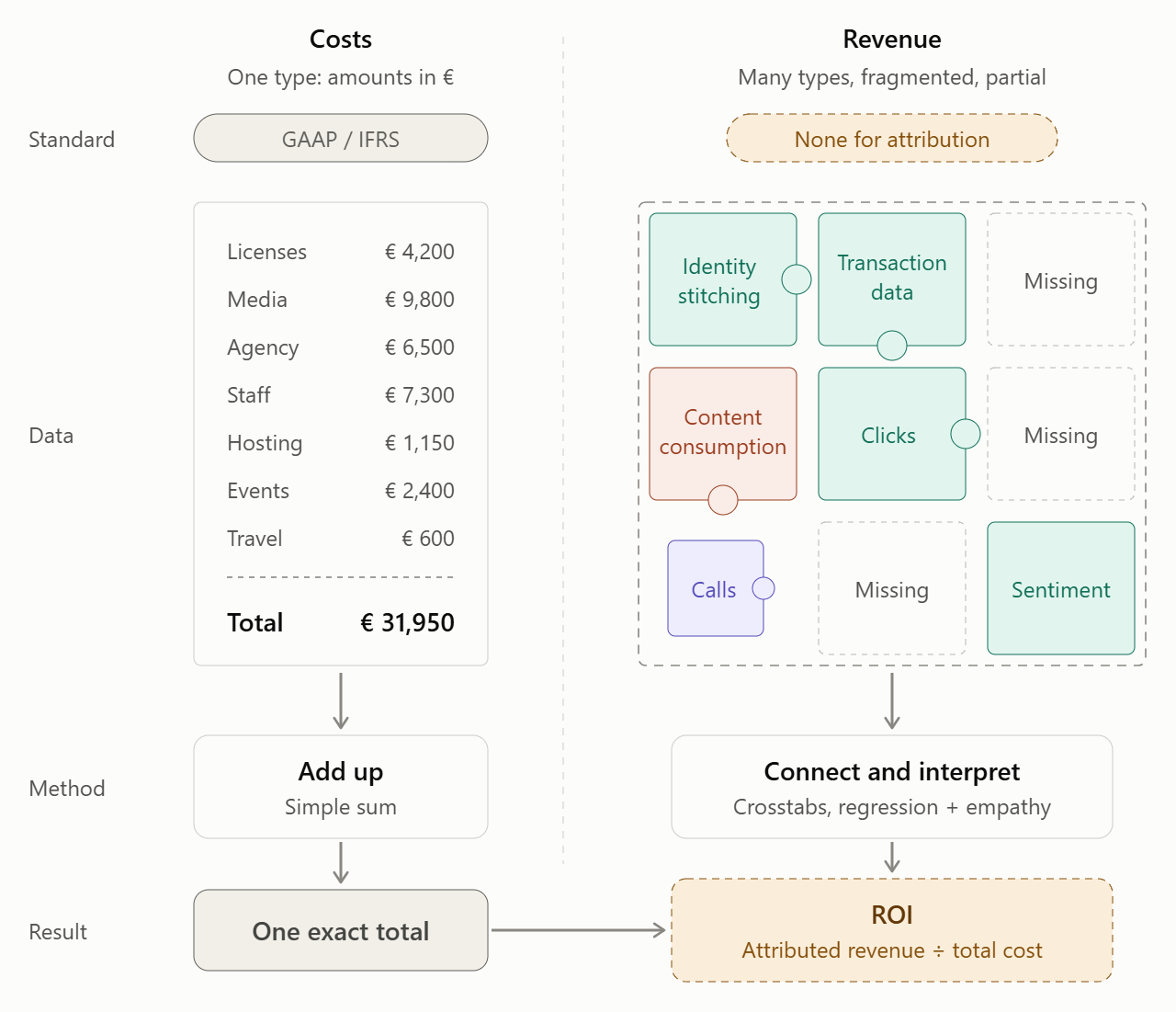
ROI looks like one calculation. Revenue divided by cost. Two numbers, one ratio. But the two numbers come from completely different worlds. They’re not the same problem at different levels of difficulty. They’re different problems.
Start with the rulebook. Costs follow accounting standards like GAAP and IFRS. Every invoice, every salary, every license fee is recorded the same way, in every company. That’s the whole point of a standard.
Yet, Marketing has nothing like it for attribution. No attribution model explains it for all. Every tool decides for itself what counts as a conversion, an engagement, or a contribution. Two platforms, same campaign, two different answers.
Then the data. On the cost side, everything is the same type: an amount in euros. Licenses, media, agency fees, staff, travel. Different lines, same format. Costs are receipts, really. A kind of glorified receipt management. Sorry, CFO.
On the revenue side, nothing is the same type. Identity data to know who’s who. Reliably. Transaction data. Content consumption. Clicks. Support calls. Sentiment. Each comes from a different system, in a different format, on a different timeline. Some pieces don’t fit together. Some are missing altogether. It’s a jigsaw where half the pieces come from other boxes.
Which brings us to the method. Costs you add up. That’s it. A simple sum, and you have your total.
Revenue you have to connect first, then analyze. Crosstabs, regression, modeling. And even then the numbers only tell you what customers did, not why they did it. Let alone if they will do it again in the future. Understanding needs, motivations, and behavior takes interpretation. And empathy. That’s not a calculation.
So look at what you end up with. On one side, one exact total. On the other side, an ROI where the denominator is exact and the numerator is a judgment.
Same formula. Two very different halves. Put those two halves in a budget meeting and watch what happens.
The Exact Number Always Wins.
The cost side arrives with receipts. Every number can be traced, checked, and audited. Nobody argues about what the agency fee was. It’s on the invoice.
The revenue side arrives with a model. Assumptions about attribution. Choices about which data to include. A regression that could have been specified differently. Every number can be questioned. And it will be. So the CFO does what any sensible person would do. They trust the half they can verify.
That one choice drives a lot of behavior. Cutting €100K in costs is a fact. It shows up next quarter, exactly as promised. Claiming €300K in extra revenue is an estimate. It shows up as a range, with footnotes, and someone in the room will doubt the method.
The fact beats the estimate. Every time.
Cost cutting starts to look like rigor. Value creation starts to look like opinion. The person who saves money is disciplined. The person who argues for investment is optimistic.
Nobody here is acting in bad faith. The CFO isn’t anti-marketing. Marketing isn’t bad at math. It’s the structure. When one side of the equation is exact, and the other is a judgment, the exact side sets the agenda.
Repeat that for a few decades, and you get exactly what we have now. Organizations that are very good at efficiency and not very good at effectiveness. Procurement processes built to squeeze costs. Martech stacks justified by the licenses they replace, not the customers they win. Business cases where the savings are precise, and the upside is a hopeful paragraph at the end.
And the cruelest part: a missed opportunity never shows up anywhere. There’s no line on the balance sheet for the revenue you didn’t create. The cost of playing it safe is invisible. The cost of investing is on the receipt.
So the default isn’t neutral. It’s tilted toward cutting. That doesn’t mean the revenue side is doomed. It means it has to play by different rules.
Make The Judgment Defensible. Put a Number on It.
Here’s the uncomfortable truth. Revenue will never be as exact as cost. There’s no GAAP coming for attribution. The jigsaw will always have pieces from multiple boxes. That’s fine. The goal isn’t to turn the jigsaw into a receipt. The goal is to make the judgment as credible as the receipt.
That’s what Value Engineering does. It turns company data into a business case that finance can follow, challenge, and approve. Definitions agreed upfront. Assumptions on the table. Conservative ROI projections. And no gains from adjacent segments or products, even when they’re obviously there. You leave money on the table on purpose, so nobody can call the number optimistic.
It doesn’t have to be a big project either. At the business school, we’ve built 46 business cases this way. Using the available company data, plus three sessions of 30 minutes per participant to support their progress. No new technology. No new data. Within three months, all plans were completed. 90% were approved by the board. 85% were implemented.
That’s not marketing asking for budget. That’s marketing showing the board what it’s about to win or lose.
My favorite example came from a content marketer. The board wanted to phase out products built on old, outdated technology. Logical move. The new technology was far more efficient. But that efficiency had a catch. With cost-based pricing, lower costs meant lower prices. She crunched the data and found that replacing the product the planned way would wipe out €18 million of annual revenue (20% of the total revenue). Augh. The cost mindset reared its ugly head.
So she changed the question. From “what does it cost to make?” to “what is it worth to the customer?” From cost-based pricing to value-based pricing. Dozens of technology-driven engineers hadn’t considered it. A content marketer did. She ended up in the boardroom.
That’s what happens when marketing talks business. Not in clicks or impressions. In money. And this matters more now than ever. AI is commoditizing execution. Content, campaigns, code, analysis. Anyone can produce it, fast and cheap.
What doesn’t get commoditized is judgment. Knowing what’s worth doing, and making the case for it. That’s becoming business critical. And it’s the career skill of the next decade. She didn’t get into the boardroom by producing more content. She got there with a judgment the board could defend.
So make a business case based on revenue uplift. Always. Your company data hides a lot of gold nuggets. The receipt will always be easier to read. But a well-built jigsaw shows a picture nobody else in the room can see.

Related posts
Keep reading for more marketing technology information!
The Retail Stack Growth Path: Sell, Orchestrate, Monetize
Why Your Marketing Budget Gets Cut. Every Time.

Marketing Is The Company's Edge: Where Value Happens