
Every senior leader has mapped their stack. Very few can show how the customer journeys flow through that stack. Let alone how revenue flows through the stack. That part is still magical and mystical.
Most of us know which tools we use. We know how many there are, which categories are growing, and which vendors are consolidating. With MartechMap.com, we’ve been mapping this for over a decade, and we’ve become very good at it. But in 2026, it looks like we’ve hit peak Martech.
That made me think: what’s next?
Well, history has a lesson for us. A present, I’d say. A handy analogy. Medicine faced the same problem after the Middle Ages.
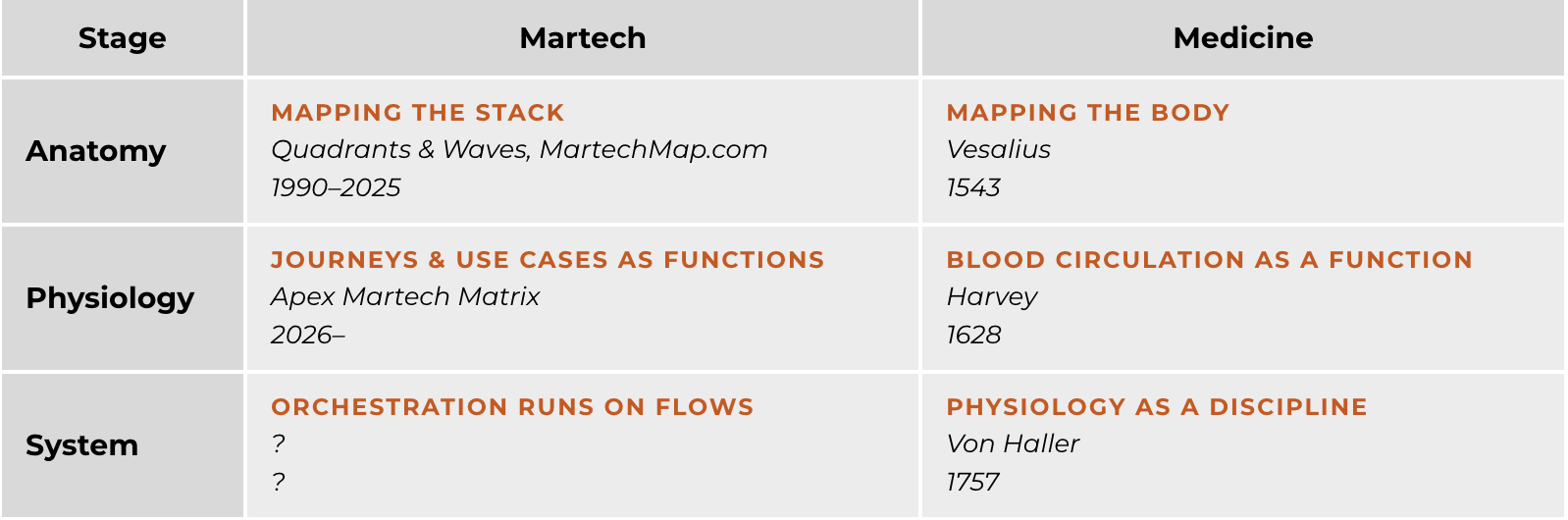
- First, it learned what the body looked like (Anatomy).
- Then it learned how the body worked (Physiology).
- Only after that did it become a discipline that could actually treat people (System).
Three stages, each roughly a century apart. How does that help Martech? The steps are recognizable.
A map of the stack is not the same as understanding it. A Martech architecture shows the parts, the anatomy. It doesn’t show how customers and value flow from one part to the next, where they get lost along the way, or which flows are not worth running at all.
Today, we’re standing at the edge of the second stage. That’s not a small step. It changes what we measure, how we organize, and what we expect from technology.
But there’s a catch. AI has everyone talking about context. Agents need it, so everyone is building it. We’re jumping straight from mapping the stack to orchestrating it. The question in between – which journeys are actually worth it – is getting lost. Except for the industry outperformers.
Medicine needed a century per stage. Let’s pray Martech won’t. But we might if we skip the middle. We’ll just be fast at the wrong thing.
1. Martech Anatomy: Mapping Martech
For 35 years, Martech has been busy with anatomy.
Analysts gave us the Magic Quadrant and the Wave. Vendors were placed, scored, and ranked. Then the landscape exploded, from around 150 tools in 2011 to more than 15,000 today. So we mapped that too. Our maps now cover every category, every vendor, every shift.
I’ve spent a good part of my career on this work. It was necessary. You can’t manage a stack you can’t see. And companies needed a shared language to talk about what they bought.
That job is largely done. We know the organs. We know which ones every company has: a CRM, a CDP, a marketing automation platform, an analytics suite. We know which ones are growing and which ones are being absorbed.
Medicine went through the same stage. In 1543, Vesalius published the first accurate map of the human body, based on his own dissections. It was a revolution. But it described the body. It didn’t explain how the body worked.
That’s where Martech is today. A stack map tells you what you have. It doesn’t tell you what value it delivers. Ask a CMO for their stack, and you’ll get a slide within minutes. Ask how value flows from first touch to revenue, and which systems carry it, and the room goes quiet.
That silence is the gap. Anatomy shows structure. It doesn’t show flow.
2. Martech Physiology: Making Martech Flow
The second stage is function. Not which systems you have, but which flows through them are worth running.
In Martech, function means use cases and customer journeys. A lead comes in. Data gets enriched. A segment triggers a campaign. Sales picks it up. A deal closes. Every step runs through several systems and several teams. That flow is the physiology of the stack.
Medicine took this step in 1628. William Harvey showed that blood circulates. He didn’t prove it by looking. He proved it by calculating: the heart pumps more blood in an hour than the body could ever produce.
That’s the lesson for Martech. A journey isn’t valuable because it exists. Most companies run dozens of them. Some carry the business. Most don’t. The question is which ones.
That’s what Value Engineering answers. Take a use case, map the systems it runs through, and calculate what it delivers. Revenue, cost, time. Then compare. Suddenly you know why you run the journeys you run.
Few companies work this way, because organizations are built around organs. Marketing owns the automation platform. Sales owns the CRM. IT owns the data platform. The journey runs straight through all of them. Nobody owns it, so nobody asks whether it’s worth it.
Most leaders know journeys matter more than tools. But in daily life, they only look at what they can steer on: adoption, license usage, channel performance. Knowing isn’t doing.
This is why we built the Apex Martech Matrix around outcomes rather than tools. Two companies can run the same platforms and get completely different results. The difference is in which flows they run, and why.
3. Martech as a System: Making Martech Work
Everyone in Martech is talking about context now. AI agents need to know what to do, in what order, and with which data. Context Engineering is how you give them that.
That’s the right direction. Orchestration is the third stage, and AI is the infrastructure that makes it possible. Just like journals and academic societies made it possible for von Haller to turn physiology into a discipline in the 1750s.
But look at what von Haller built on. He codified physiology in one textbook because Harvey had already proven the function. The discipline stood on proof.
Martech is trying to build the discipline without the proof. Context Engineering tells an agent how to run a journey. It doesn’t tell anyone whether that journey should run at all. Without value, you get perfectly engineered context for flows that don’t matter. You orchestrate the wrong journeys, faster.
In practice, the order often flips. You need some context before you can calculate value, and that’s fine. But the field has to move in the order of proof: first why a flow matters, then how to run it. Everyone is talking about context. Almost nobody is talking about value.

Related posts
Keep reading for more marketing technology information!
From Martech Anatomy to Martech Flow
AI Isn’t Eating SaaS. It’s Splitting The Stack.
The Retail Stack Growth Path: Sell, Orchestrate, Monetize