

Composability isn’t a trend. It isn’t a strategy either. It’s how technology works. Technology mirrors the ecosystem it must support: customers, teams, partners, and systems, all interacting with each other and their environment.
Every martech vendor has an “ecosystem”. Usually it means a partner page or an app marketplace. Some look more like a list than an ecosystem. “Ecosystem” is rarely understood, let alone taken advantage of. The life of an ecosystem isn’t in its parts. It’s at the edges, where the parts meet and exchange.
Permaculture, an ecological design framework, has a principle for this: use edges - value the marginal. Where forest meets meadow, or land meets water, you find the most variety of life and the most exchange. Good design doesn’t avoid the edge. It makes the most of it. The edge works like a membrane. It lets things in and out, selectively.
That’s what openness in your technology stack really is. Not wide open. A membrane that filters. We scanned 14,747 martech vendors. Two out of three mention an API. That’s the membrane toward other systems, and it’s mature. But a new actor is arriving at the edge: agents. MCP is the membrane toward them. One vendor in nine mentions it.
So the stack exchanges well with systems, but barely with agents. And agents are exactly what every board is betting on right now. The question is which edge to open first.
1. Open The Inner Edge First
Look at where MCP shows up first. It’s not where most people would expect.
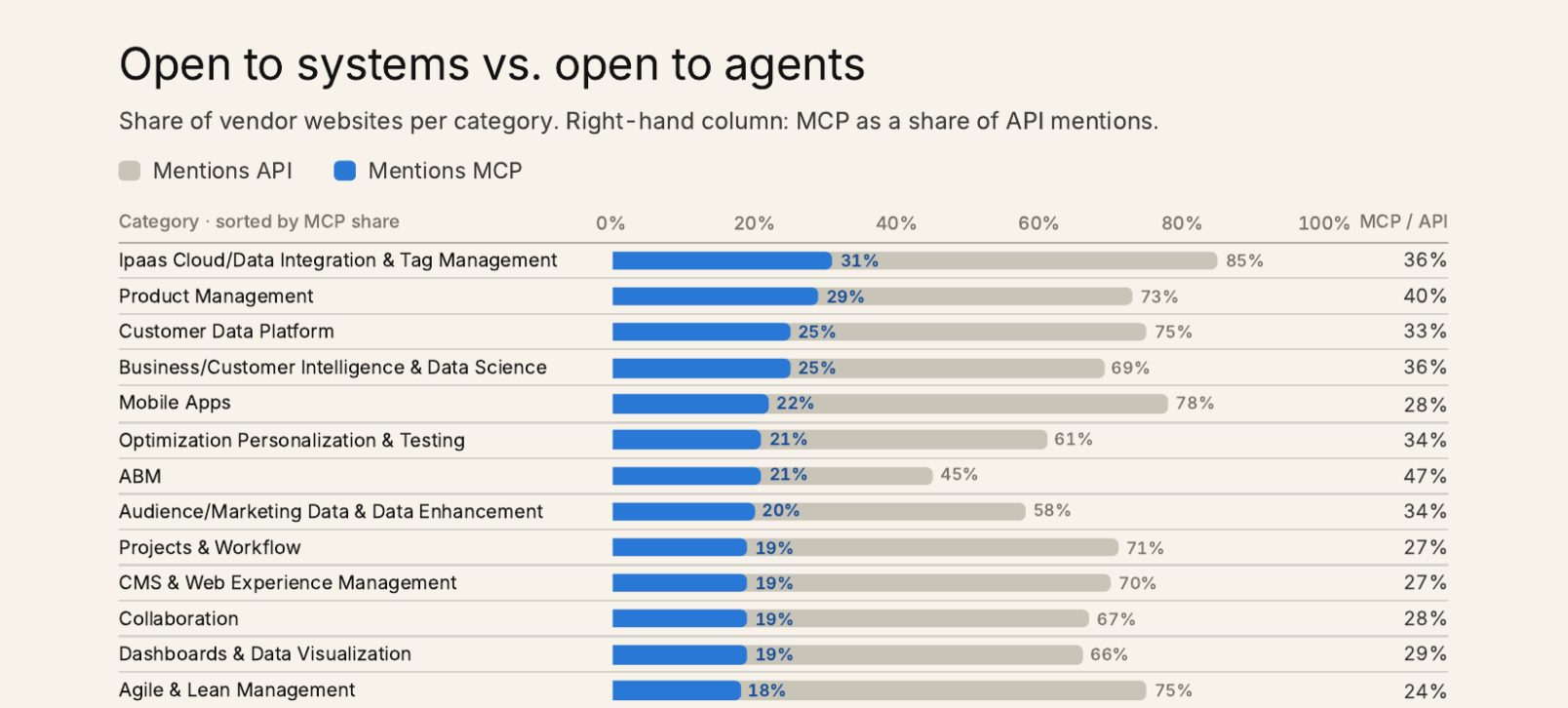
- iPaaS leads at 31%.
- Product Management follows at 29%.
- CDP and BI & Data Science are at 25%.
- Then comes a pack of work tools: Projects & Workflow, Collaboration and Dashboards, all at 19%, and Agile & Lean Management at 18%.
For comparison, the median category sits at 11%.
These tools have one thing in common. They live at the edge by design. An iPaaS has no job other than exchange. A CDP exists to pull data in from everywhere and push it out again. A BI tool reads from everything. These tools were born as membranes, so it’s no surprise they’re the first to let agents through.
Mobile Apps (22%) and CMS (19%) are up there too. They’re customer-facing, yes. But they’re builder tools. Developers use them to build the experience, not marketers to run it.
This is the inner edge, where systems meet systems. It makes sense that it opens first. An agent is useless without context. Before it can do anything, it needs to know who the customer is, what happened before, and what the rules are. That context lives here.
It’s also the safest edge to open. It’s internal. If an agent gets something wrong, the mistake stays inside the house. No customer sees it.
Now the caution. Starting at the inner edge is inside-out, and inside-out is not how you design a stack. Just don’t confuse the starting point with the destination. That’s the beginner mistake. You design outside-in. You start from the customer and work your way back to the systems that serve them. That’s where value happens.
So why start inside? Because nobody starts from a blank page. Unless you are a startup, you probably have some legacy. Your engagement platforms were bought years ago, and most of them aren’t opening to agents yet. You can’t wait for them. The inner edge is the part of your stack you can open today.
What happens at the outer edge is where the company meets the customer. So the real question is whether that edge is open.
2. The Outer Edge Is Where Value Happens. It’s Still Closed.
The inner edge feeds the ecosystem. The outer edge is where it earns the company its living. This is where the company meets the customer: the campaign that goes out, the email that lands, the lead that gets routed, the order that gets placed. That’s marketing’s territory. Marketing is the company’s edge. This is where value happens.
That edge is still mostly closed to agents. Look at the engagement stack.
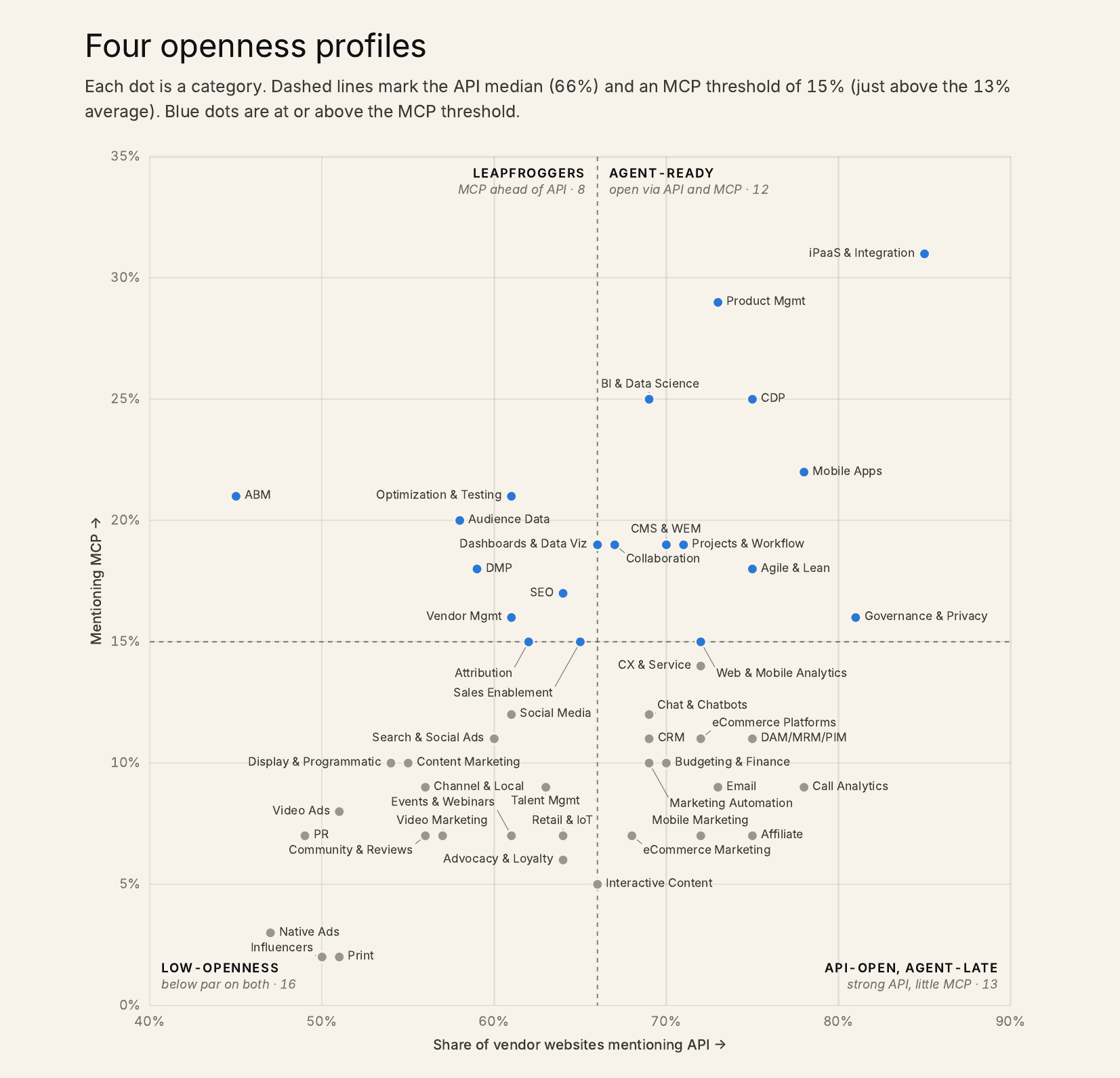
These are not closed tools. They exchange with other systems just fine. Their membrane simply lets systems through and keeps agents out. In the chart below, they cluster in one corner: API-open, agent-late. That’s 13 categories, and they are exactly the platforms most stacks are built around.
Now be careful how you read that. In nature, the outer edge is the richest zone. It’s also the most exposed one. The same goes for a stack. This is where customer data sits, where your brand speaks, and where one wrong action gets sent to a million people. A vendor that keeps agents out here may simply be filtering on purpose.
Or it may just be slow. A mention on a website can’t tell caution from lag. Probably it’s a bit of both.
What the data does tell you is that it’s a choice. Opening to agents isn’t something that comes automatically with being open to systems. API and MCP move together only loosely, with a correlation of 0.43. A strong API doesn’t predict an MCP. That’s why the stack splits into four openness profiles.
Source: MartechTribe and chiefmartec scan of 14,747 martech vendor websites. A mention signals intent, not a shipped capability.
ABM proves the point. It has the lowest API score of all 49 categories, at 45%. Yet it sits in the MCP top seven at 21%. Its MCP share is nearly half its API share. No category comes close to that ratio. ABM didn’t wait for a mature API layer. It went straight to agents.
ABM isn’t alone. Audience Data, DMP, Optimization & Testing, and Attribution show the same pattern. They’re the leapfroggers: outer-edge tools that run on data. When the vendor decides agents belong at the edge, the edge opens. Maturity has little to do with it.
So the closed outer edge isn’t a law of nature. It’s a decision. If you leave it undecided, your vendor makes it for you. That’s the wrong party to make it. Design the membrane yourself.
3. The Edge Is Where Value Meets Context
Designing the membrane doesn’t mean throwing every edge wide open. A healthy membrane filters. It lets the right things in and keeps the wrong things out. The real question is what “right” means. That takes two disciplines, working the same edge from two sides.
- Without oxygen, an organism dies.
- Without the customer, an organisation dies.
Value engineering decides what the membrane lets in and out, and which exchanges are worth it. It reverse-engineers from outcomes: which customers, which journeys, which exchanges actually create value. Not every edge deserves an agent. Some edges deserve several agents. Some deserve none. Value engineering is how you tell them apart.
Context engineering builds the membrane at those edges. It makes company knowledge machine-readable and customer understanding actionable, so an agent can act on it. An API did that for systems. MCP now does it for agents.
Value decides where. Context decides how. Neither works alone.
Value engineering without context engineering is a strategy your agents can’t execute. Context engineering without value engineering opens edges nobody needs. That’s risk without return.
Our research has a telling example. Unexpectedly, Governance & Privacy is one of the most open categories in the whole set, with 81% mentioning an API. The tools whose job is to filter are themselves wide open to exchange. That’s what a membrane looks like: open, and in control.
Ecosystems were always about openness. So is composability. Openness was always about the edge. And the edge is where value and context meet. Design outside-in. Execute inside-out. Let value engineering choose the edge and context engineering build the membrane. The next stack advantage isn’t how many tools you connect. It’s what your outer edge lets your agents do for the customer.

Related posts
Keep reading for more marketing technology information!
Marketing Is The Company's Edge: Where Value Happens
Value Engineering #2 - Stop Optimizing Campaigns. Optimize Revenue.
How to Put a Missed Opportunity on the Balance Sheet